
Yes, the archaeological city of Pompeii is wheelchair accessible through a specific itinerary called Pompei per tutti, although the terrain outside this route presents significant obstacles, as wheelchair access in Pompeii is limited by the original Roman cobblestones and uneven ground.
| Pompeii area | Accessibility level | Terrain characteristics |
|---|---|---|
| Pompei per tutti route | High | Ramps, leveled floors, and elevated crossings. |
| Amphitheater | Medium/High | Accessible via the specific route from Piazza Anfiteatro. |
| Secondary roads | Very low | Irregular stones, high curbs, and a lack of ramps. |
| Domus interiors | Variable | Some houses have walkways; others retain original steps. |
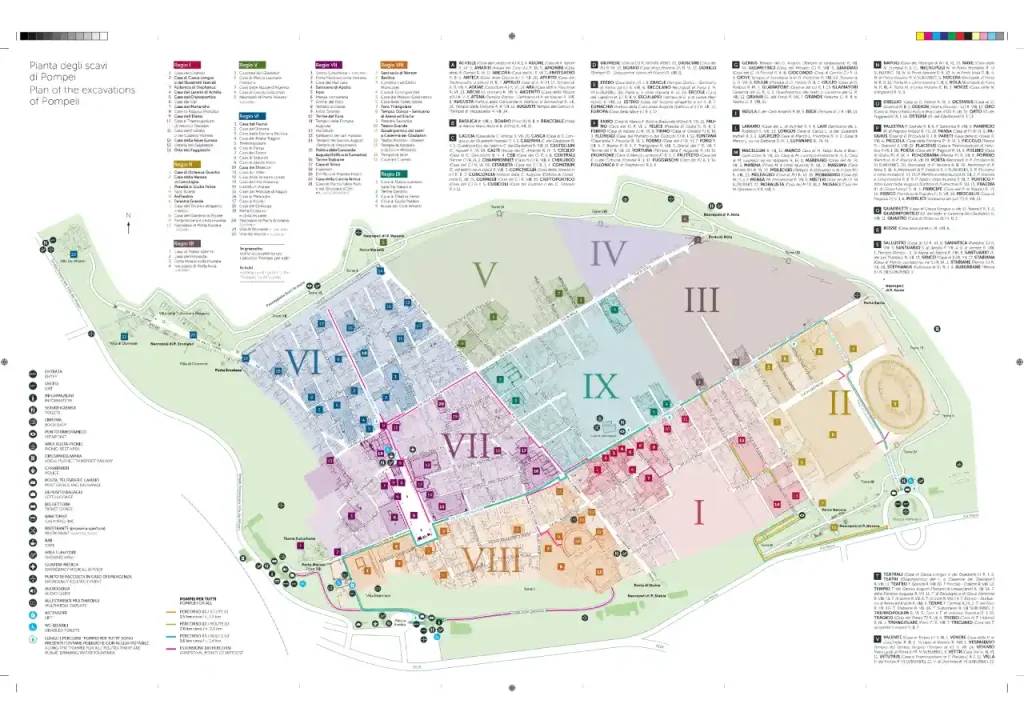
Pompei per tutti (or “Pompeii for all”) is the inclusion project of the Pompeii Archaeological Park designed to facilitate visits for people with reduced mobility, wheelchair users, parents with strollers, and any visitor who prefers a more comfortable tour. This itinerary covers approximately 3.5 kilometers, connecting the Piazza Anfiteatro entrance with the Sanctuary of Venus and the Forum. The initiative uses modern materials to level surfaces and bridge the historical gaps between sidewalks and Roman roadways.
The route allows for the observation of major structures, such as the Large Gymnasium and several restored residential houses (domus). Users can consult the official accessibility map to identify rest points and suggested routes:
According to a Facebook user: “About a quarter of the site is accessible.” Despite these improvements, the experience can vary depending on the equipment used, as evidenced by a testimony from another person on Facebook: “I was there in September and managed to get around a good part of it in a power wheelchair and, while I’m glad I did it, it was a bit scary in parts and maybe I shouldn’t have, especially when I almost fell out, but luckily I was rescued by a passing couple.”
The best entrance to Pompeii for people with reduced mobility is Piazza Anfiteatro. This access point serves as the official start of the accessible Pompeii per tutti itinerary and lacks the steep slopes that characterize other main entrances, such as Porta Marina. From Piazza Anfiteatro, visitors directly access the flattest and best-equipped areas of the archaeological park.
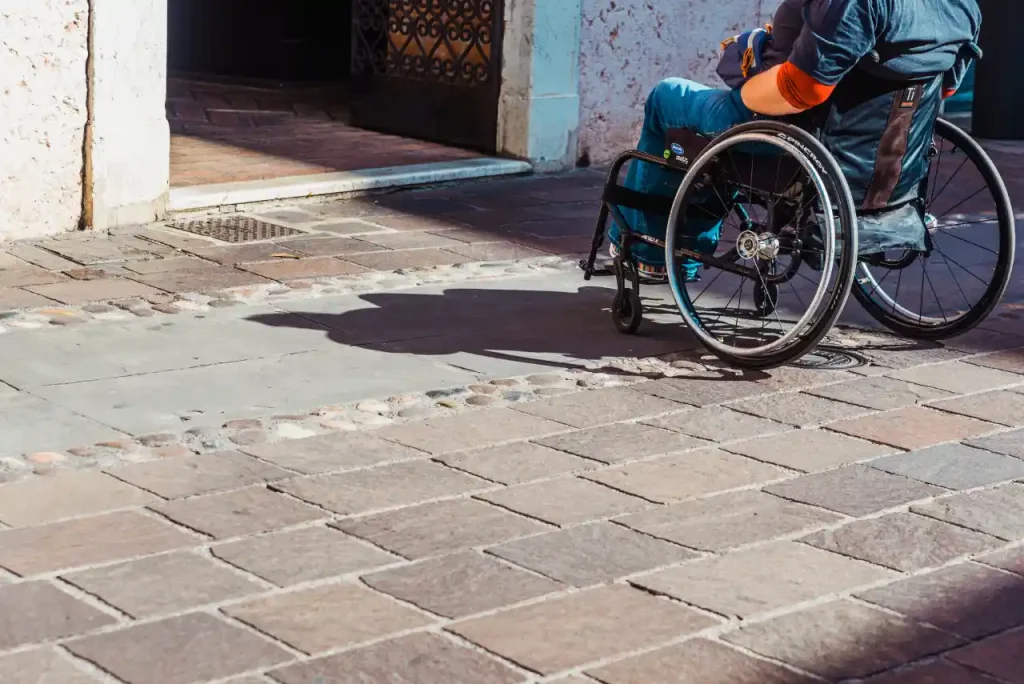
Roman urban design conditions accessibility in Pompeii. The ground consists mostly of basalt, a type of volcanic stone that is extremely hard and irregular. This paving features deep gaps and convex surfaces that hinder wheel traction. As a Quora user states: “Pompeii requires a huge amount of walking on old irregular paths.”
Although the accessible route slightly mitigates these problems with walkways and ramps, cobblestone ground is present throughout almost the entire complex. The original streets possess high curbs designed to channel rainwater, which forces users to rely exclusively on points where metal or wooden ramps are installed. Outside the main axes of the inclusive route, autonomous wheelchair travel is practically unfeasible due to the lack of supporting infrastructure.
As mentioned in the initial table, the non-accessible areas of Pompeii comprise most secondary streets, areas with steep slopes, and the upper levels of excavated buildings. Difficulties derived from the cobblestone ground are constant in these zones, where the original basalt has not been covered or leveled for tourism. According to a Reddit user: “there are no handrails or anything like that, nor many benches to sit on. The most of the park is a very irregular stone path.”
The cobblestone ground is not uniform throughout the complex; while main roads (like the Via dell’Abbondanza) have adapted sections, smaller intersections retain Roman “stepping stones.” These stones are elevated blocks that cross the street from sidewalk to sidewalk, acting as impassable physical barriers for a wheelchair.
Additionally, many of the smaller domus (houses) feature elevated stone thresholds and narrow hallways that prevent a wheelchair from turning. As the complex’s official website indicates, areas located on the hills in the northern sector of the park also present slopes exceeding 8%, classifying them as non-accessible according to international mobility standards. Finally, the lack of signage in these remote areas increases the risk of becoming trapped on unstable terrain.
Yes, the Pompeii Archaeological Park offers a free wheelchair rental service in Pompeii for visitors who request it. These chairs are available at the information offices located at the main entrances of Porta Marina and Piazza Anfiteatro. The number of units is limited, so arriving early in the morning is recommended to ensure availability, as a guaranteed prior reservation is not always possible.
It is essential to highlight that the wheelchairs provided by the park are standard manual models. Given that the terrain is irregular, using a manual chair can be exhausting for both the companion and the user. As mentioned previously, wheelchair access in Pompeii requires physical strength due to the bumps and the inclination of certain sections.
Users with severe reduced mobility are encouraged to consider using their own electric wheelchairs or power-assist systems, always keeping necessary safety precautions in mind. Park staff can offer informational assistance regarding the route, but they do not perform functions such as pushing or transporting visitors through the ruins.
POMPEII TICKETS
TOURIST INFORMATION


