
How long does it take to visit Pompeii?
Planning a trip to the ruins requires managing your time to ensure you see the main areas. In this guide, we explain how long does it take to visit Pompeii based on different routes. We also provide the facts and route options you need to organize your schedule before you arrive.
Duration of a visit to Pompeii
Here’s what you need to know upfront: a standard visit takes around 3 to 4 hours if you want to see the main highlights without feeling like you’re in a race. This gives you enough time to walk through the Forum, explore some of the best-preserved houses, and catch your breath at a couple of the most fascinating spots.
If you just want the essentials, you can sprint through in 2 hours, but you will miss the famous Villa of the Mysteries. On the other hand, history buffs could easily spend a full day here. Keep in mind that if you book a guided tour, they typically guide you for about 2 hours inside the ruins before leaving you free to wander on your own.
Here is a quick breakdown to help you plan (check the hours to plan your visit):
| Visit Type | Express Visit |
|---|---|
| Duration | 2 hours |
| What You'll Cover | Forum area, main temples, plaster casts |
| Best For | Cruise passengers or tight schedules |
| Visit Type | Standard Tour |
|---|---|
| Duration | 3-4 hours |
| What You'll Cover | Commercial districts, residential houses, amphitheater, main baths |
| Best For | Most visitors and families |
| Visit Type | In-Depth Exploration |
|---|---|
| Duration | 5-7 hours |
| What You'll Cover | Everything above plus Villa of the Mysteries, far corners, new excavations |
| Best For | History enthusiasts and photographers |
| Visit Type | Relaxed Two-Day Visit |
|---|---|
| Duration | 2 days (3-4 hours each) |
| What You'll Cover | Complete site at comfortable pace with time to absorb details |
| Best For | Those wanting the full experience without fatigue |
| Visit Type | Wheelchair-Accessible Route |
|---|---|
| Duration | 3-4 hours |
| What You'll Cover | 3.5 km accessible path covering key sites along Via dell'Abbondanza |
| Best For | Visitors with mobility needs |
Is it difficult to walk around Pompeii?
You need to know that Pompeii is not a museum with smooth floors, instead, it is a disaster zone frozen in time. The streets are paved with original Roman basalt stones that are uneven, slippery, and have large gaps between them. Honestly, this is the main reason people get tired. If you wear flip-flops or ballet flats, you are practically asking for a sprained ankle. You should definitely wear sturdy sneakers with good support.
Regarding accessibility, the site can be tough. While there is a specific route called “Pompeii for All” that stretches 3.5 kilometers, it is not perfect. It uses ramps and flattened earth to help you navigate, but there are still slopes and bumpy transitions.
If you use a wheelchair, it is wheelchair friendly enough to see the main sights like the House of the Menander, but you must enter through Piazza Anfiteatro to avoid the steep hills at other gates. If you decide to take a tour, make sure they know about your mobility needs beforehand. The Porta Marina entrance involves steep inclines that are brutal for manual wheelchairs. Some ramps along the accessible route still have gradients exceeding 8%, so if you’re using a manual wheelchair, you might need assistance in spots. The surfaces vary too, and while they’ve smoothed transitions, you’ll still feel small bumps and vibrations where modern ramps meet ancient stones.
The site also offers additional inclusivity features like guides for visitors with intellectual disabilities and “Silent Visits” with Italian Sign Language interpreters. The Antiquarium museum near Piazza Esedra has an elevator, which makes accessing the artifact collection much easier.
And if you’re bringing luggage? Don’t. Bags larger than 30 x 30 x 15 cm aren’t allowed inside to protect the frescoes in narrow corridors. There’s a cloakroom at the entrances, but it fills up fast. The more reliable option is the luggage storage at Pompei Scavi train station (about €8-€10), especially if you’re visiting between hotels.
Essential tips to see the whole ruins

Essential tips to see the whole ruins
To ensure your visit is memorable for the right reasons, you need to plan for the elements:
- Beat the heat: Bring a hat, sunscreen, and a refillable water bottle. There is almost no shade, and the stones absorb intense heat. You can refill your bottle at the ancient fountains inside.
- ID Required: Since November 2024, tickets are nominative and non-transferable. You must show your ID at the turnstile to enter.
- Timing and entrance: Arrive around 8:30 AM to beat the crowds. Use the Piazza Anfiteatro entrance instead of the crowded Porta Marina for shorter lines.
- Bag restrictions: Large luggage is banned. Bags must not exceed 30 x 30 x 15 cm, and cloakroom space is very limited.
- Footwear: Wear comfortable, closed-toe walking shoes, as the ancient stone streets are uneven, dusty, and require hours of walking.
What you'll actually see inside?
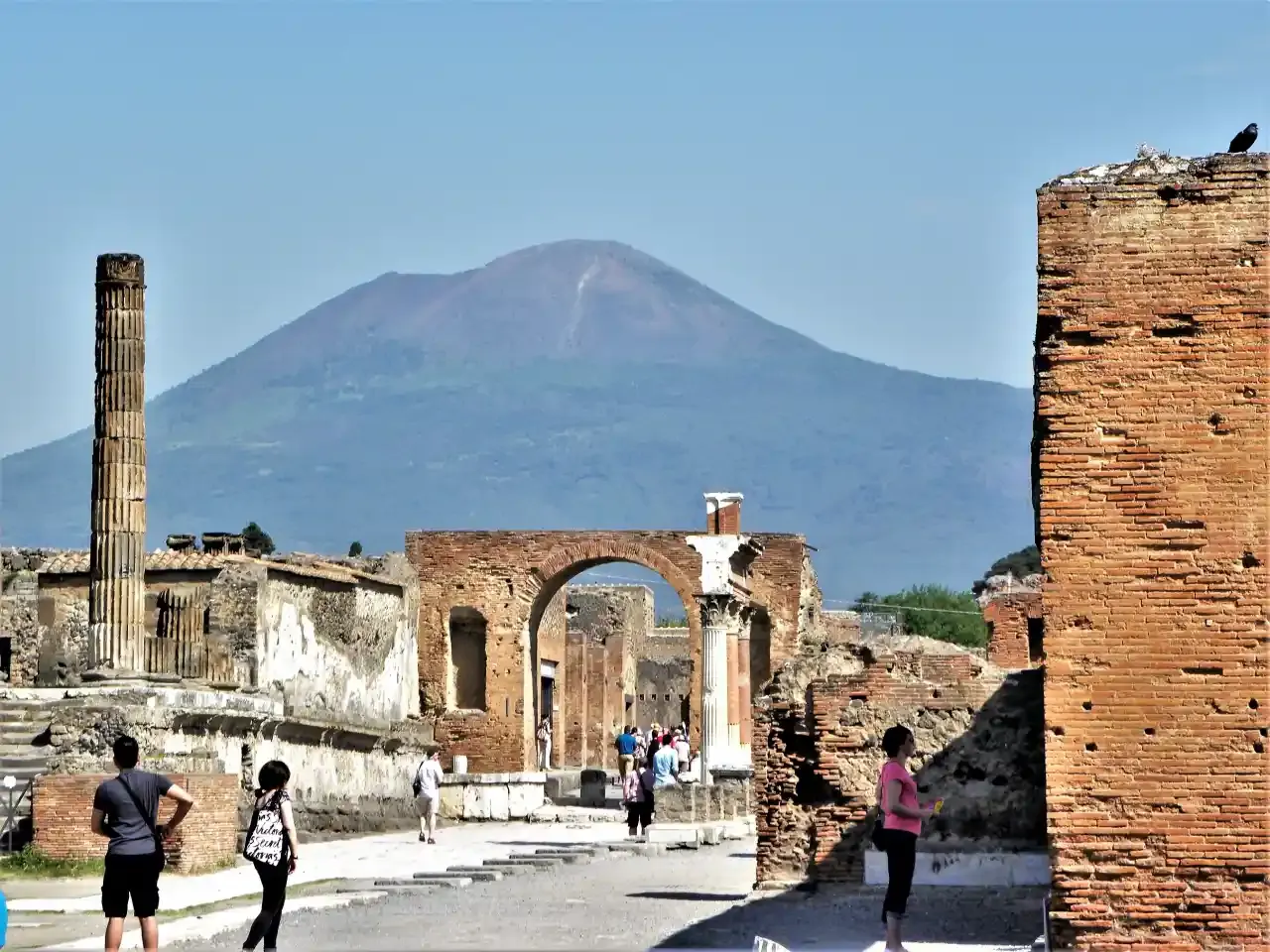
Pompeii is much more than just broken columns. You are going to walk into a living city where you can see fast-food joints (thermopolia), intricate mosaics, and even the plaster casts of the victims which are incredibly moving. It isn’t just a dry list of monuments, it is a peek into daily Roman life. It's definitely worth a visit.
Here is a strategy for what you can cover based on your time:
| Duration | Best Route & Highlights |
|---|---|
| 2 Hours | The Essential Impact. Enter at Porta Marina. See the Forum, the Temple of Jupiter, the Forum Baths, and the Basilica. It is a "greatest hits" run. |
| 4 Hours | The Roman Life. Enter at Piazza Anfiteatro. See the Amphitheater, walk down Via dell’Abbondanza, visit the Lupanar (Brothel), and explore private homes like the House of the Menander. |
| 6 Hours | Complete Immersion. Do everything in the 4-hour route, plus head out to the necropolis and the stunning Villa of the Mysteries to see the best frescoes in the city. |
Can I visit Pompeii and Herculaneum in one day?
It is possible, but it is exhausting. Pompeii is the “macro” experience, huge and overwhelming, while Herculaneum is the “micro” experience, smaller but better preserved with wood and upper stories still intact.
If you are determined to do both, start early (around 08:30 AM). Visit Herculaneum first or last, but remember that the walk from the Herculaneum station is steep. For most people, doing one per day is much more enjoyable.