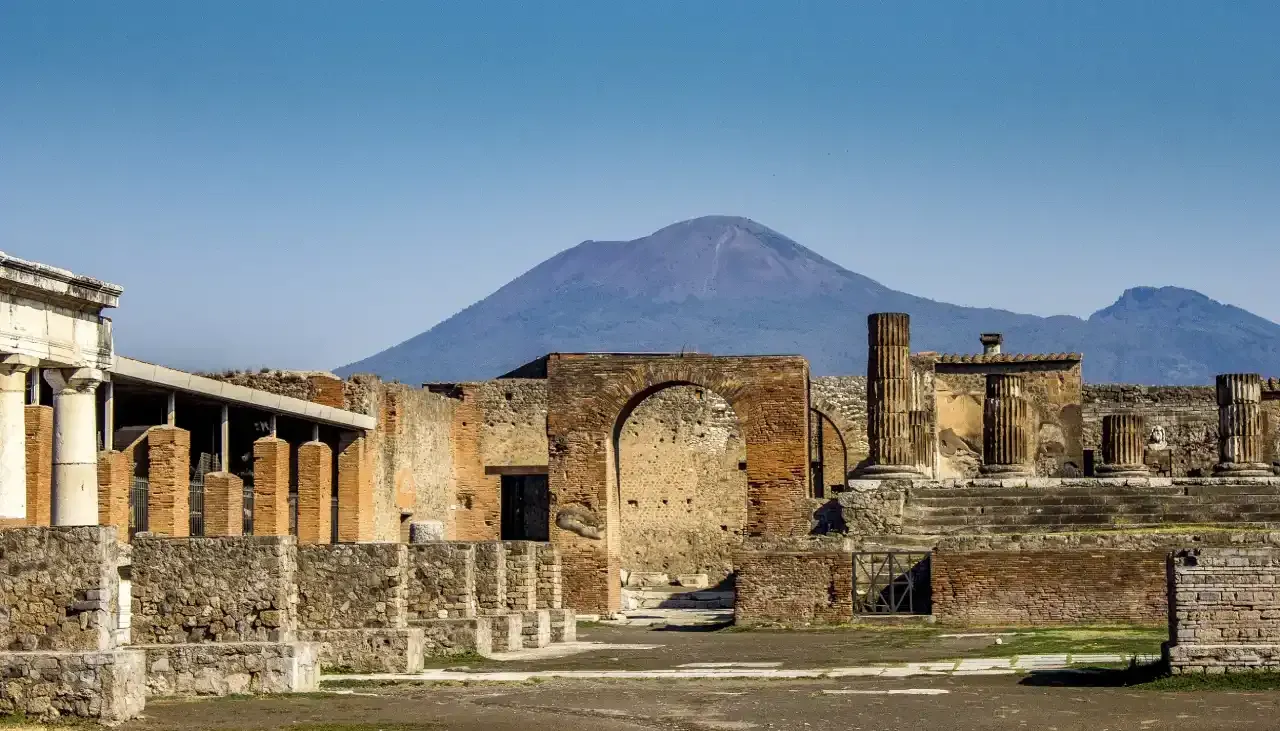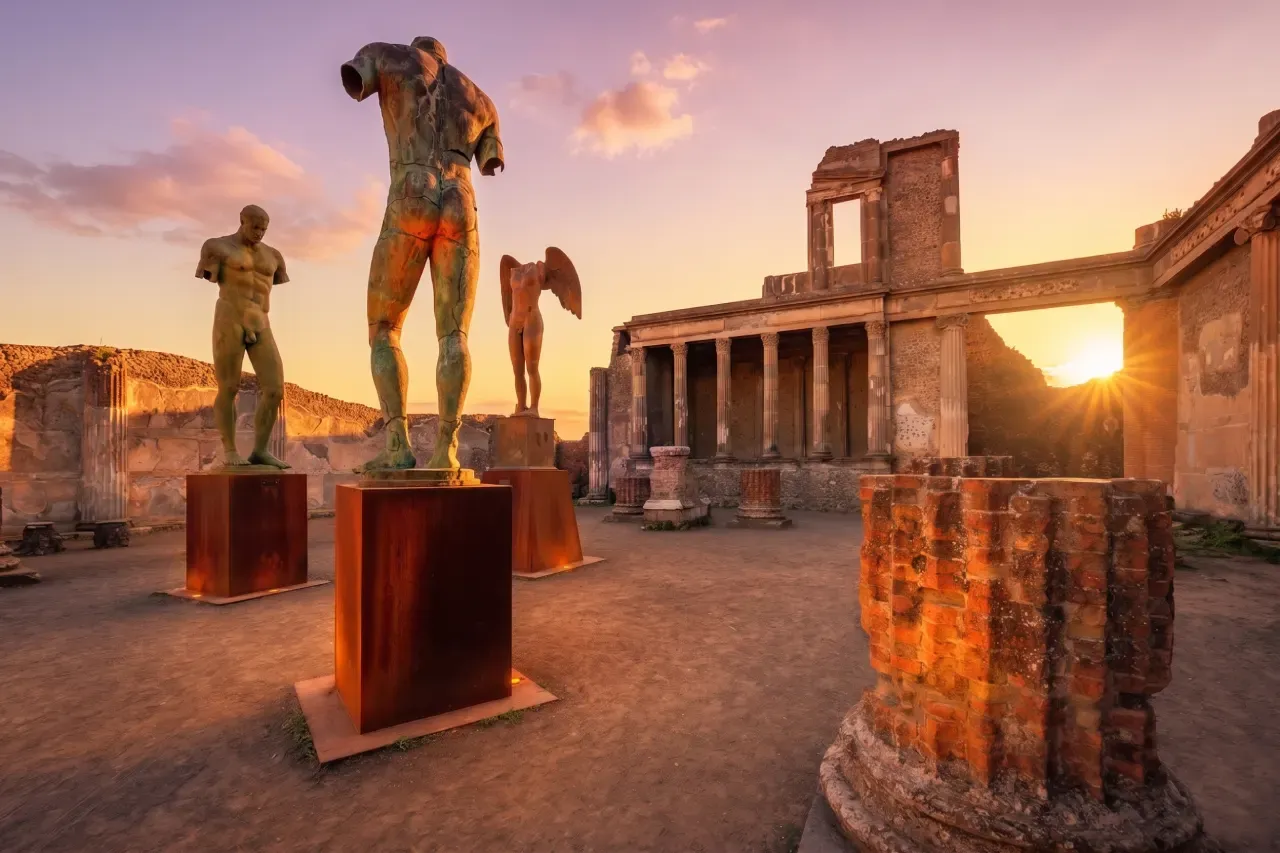
What can you do inside Pompeii?
Exploring the ruins reveals an array of attractions in Pompeii, offering a glimpse into life during the Roman Empire. From the Amphitheatre to the preserved villas, these structures showcase the city's past. Discovering these archaeological sites makes any visit to this heritage destination memorable.
Top 8 must-see inside Pompeii
Look, Pompeii covers roughly 66 hectares (that’s about 163 acres), and you could spend weeks exploring every corner. But if you’re working with limited time (and most of us are) there are certain spots you absolutely cannot miss. These eight highlights represent what made Pompeii extraordinary:
1. The Forum
1. The Forum
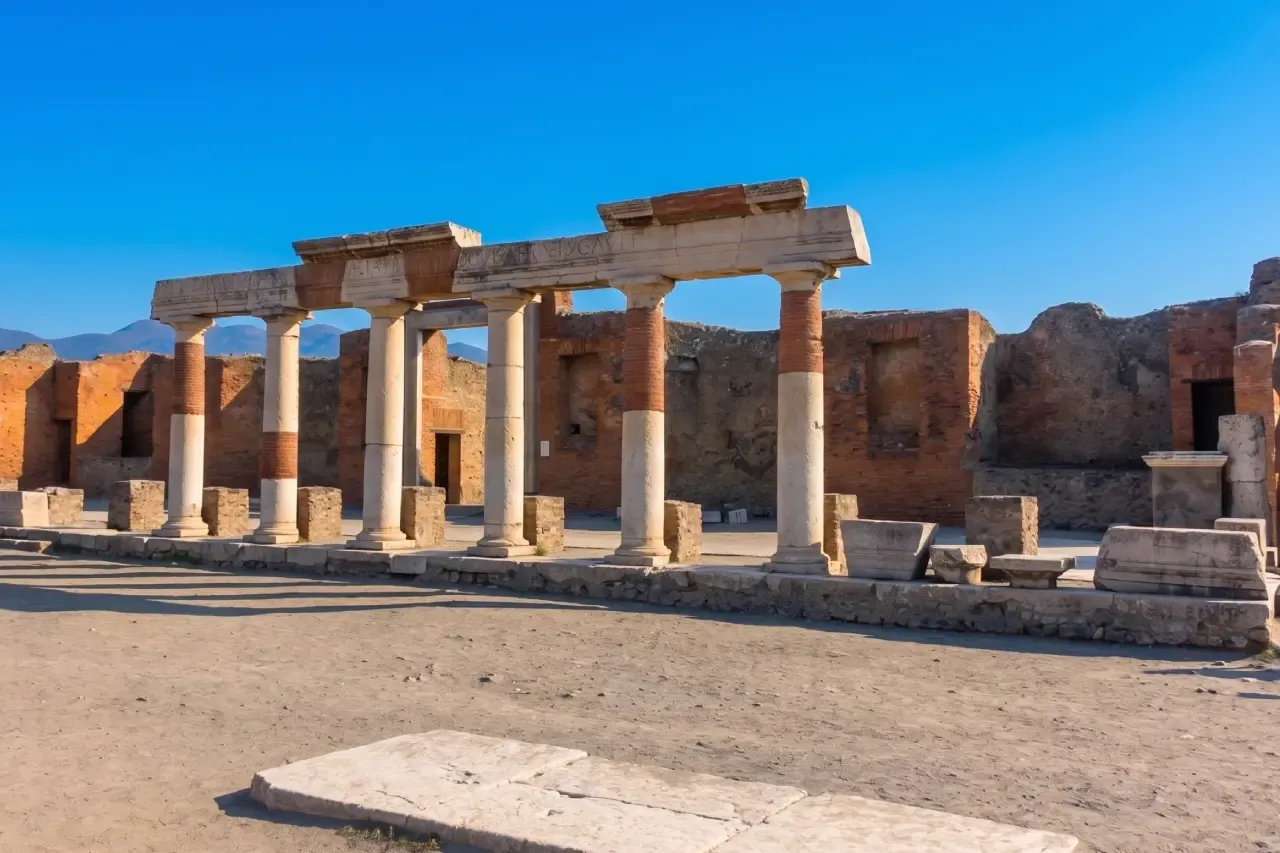
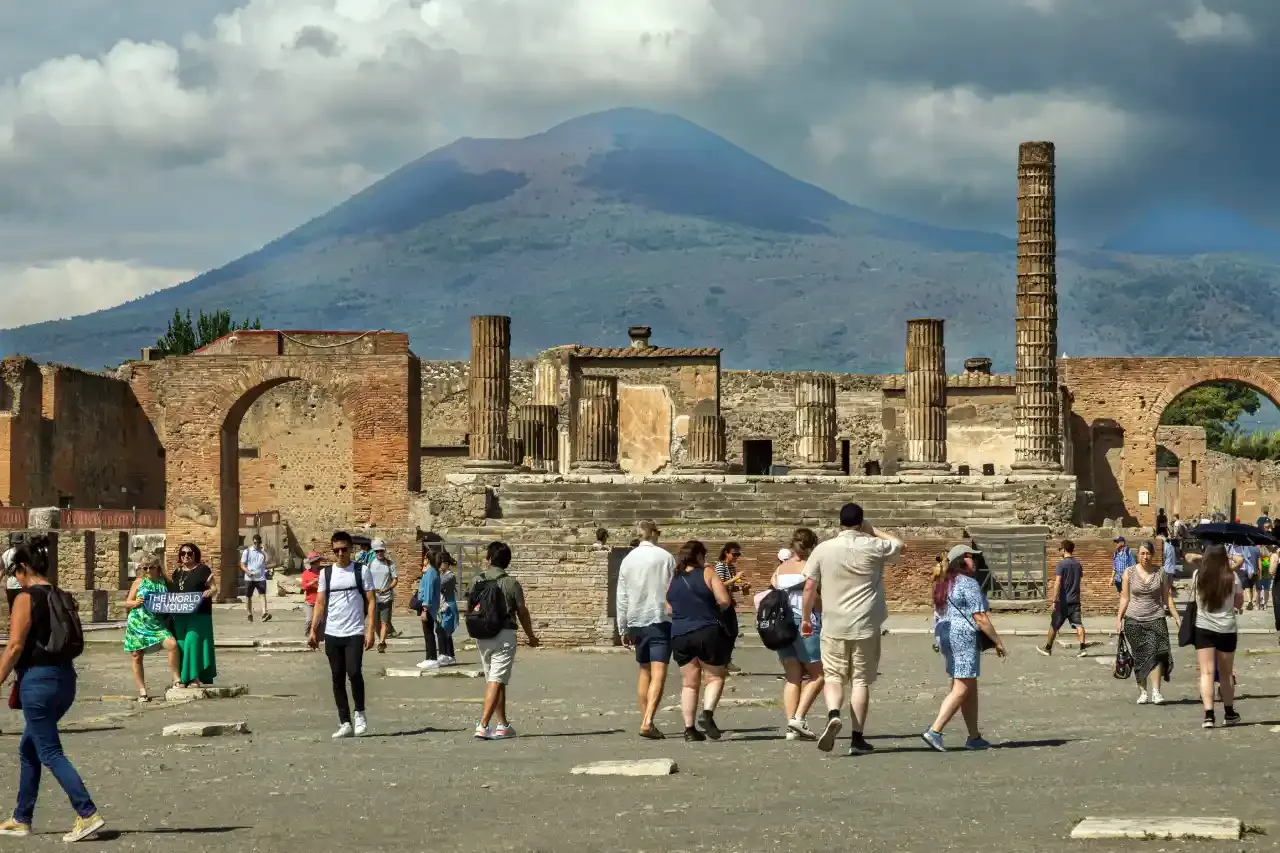
Stand in the Forum, and you’re standing at the crossroads of everything that mattered in Roman Pompeii. The Forum was the city’s commercial, political, and religious core.
Picture it: merchants hawking goods under colonnaded porticos, lawyers arguing cases in the Basilica, priests making offerings at multiple temples, citizens gathering to hear official announcements.
What makes the Forum truly special is how it tells Pompeii’s cultural evolution in architecture. The Temple of Apollo, with origins reaching back to the 6th century BC, speaks to the city’s Greek roots. Later, the massive Temple of Jupiter was built to dominate the northern end, a stone declaration that Rome was now in charge. You’ll even find the Temple of Isis here, dedicated to an Egyptian goddess (proof that Pompeii was a cosmopolitan melting pot where Eastern mystery cults found enthusiastic followers).
2. The Amphitheatre
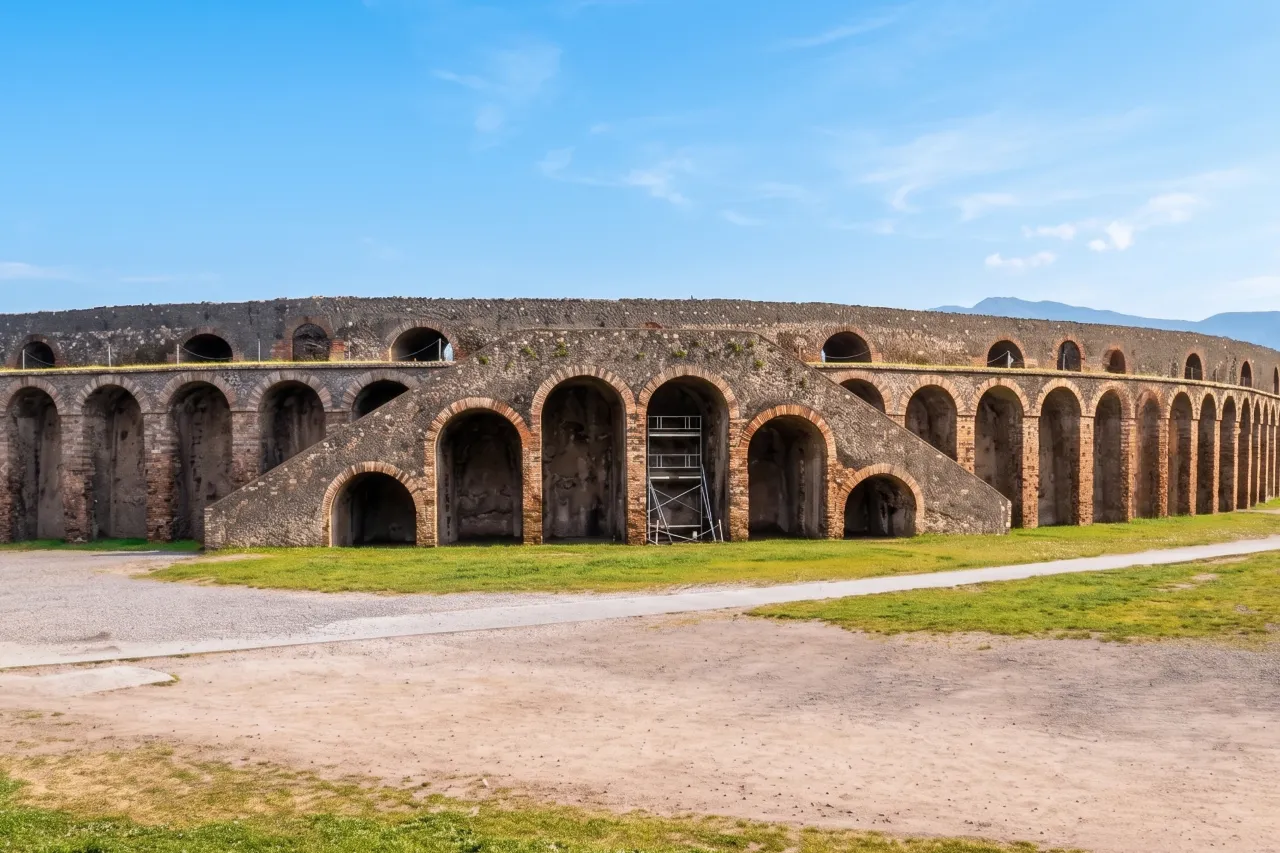
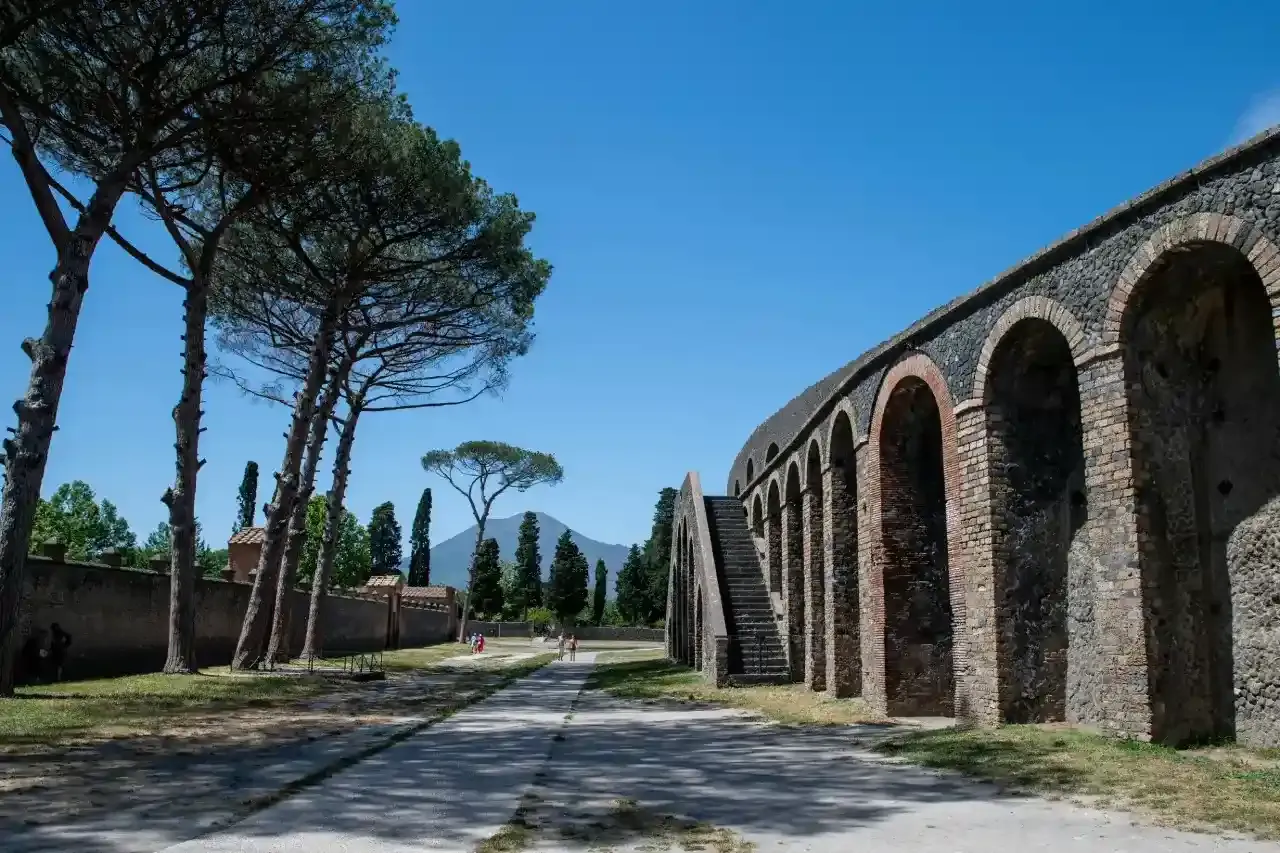
Walk to the southeastern edge of the city, and you’ll encounter the oldest stone-built Roman amphitheatre still standing. Built around 70 BC, this arena predates Rome’s famous Colosseum by more than a century.
The amphitheatre was where Pompeians came to watch their version of reality TV: gladiatorial combat. These weren’t just mindless bloodbaths (though they were certainly bloody). Gladiators were celebrities, their names and victories scratched into walls with the kind of fervor modern fans reserve for rock stars. One bit of graffiti calls the Thracian fighter Celadus “the heartthrob of the girls.”
But the amphitheatre’s most infamous moment had nothing to do with planned entertainment. In 59 AD, a gladiatorial show descended into a massive riot between Pompeian fans and visitors from the rival town of Nuceria. What started as shouted insults turned into a full-scale brawl with stones and swords. The violence was so severe that Emperor Nero imposed a ten-year ban on all games as punishment. A vivid fresco found in a nearby house captures the chaos.
3. House of the Faun
3. House of the Faun
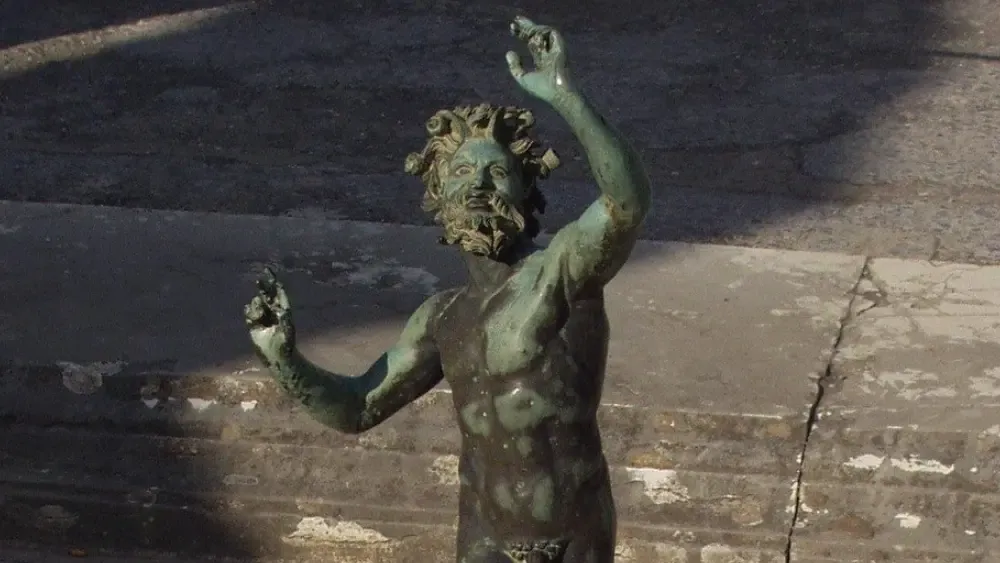
Step through the entrance of this massive residence, and you’re entering the private world of Pompeii’s ultra-elite. Occupying an entire city block at 3,000 square meters, the House of the Faun was a statement of power, wealth, and cultural sophistication.
The real showstopper is this intricate sculpture, originally placed to crown the central rainwater basin of the atrium. This masterpiece depicts a mythical faun in a dynamic pose, executing a rhythmic dance with outstretched arms and a slightly arched back. You can see the detail in his wild hair, the intensity in his facial expression, and the athletic definition of his form frozen in time.
The house was essentially a private museum, using art to broadcast the owner’s elite status to every visitor who crossed the threshold. The original mosaic is now safely displayed at the Naples Archaeological Museum, while a replica marks its original location.
4. House of the Vettii
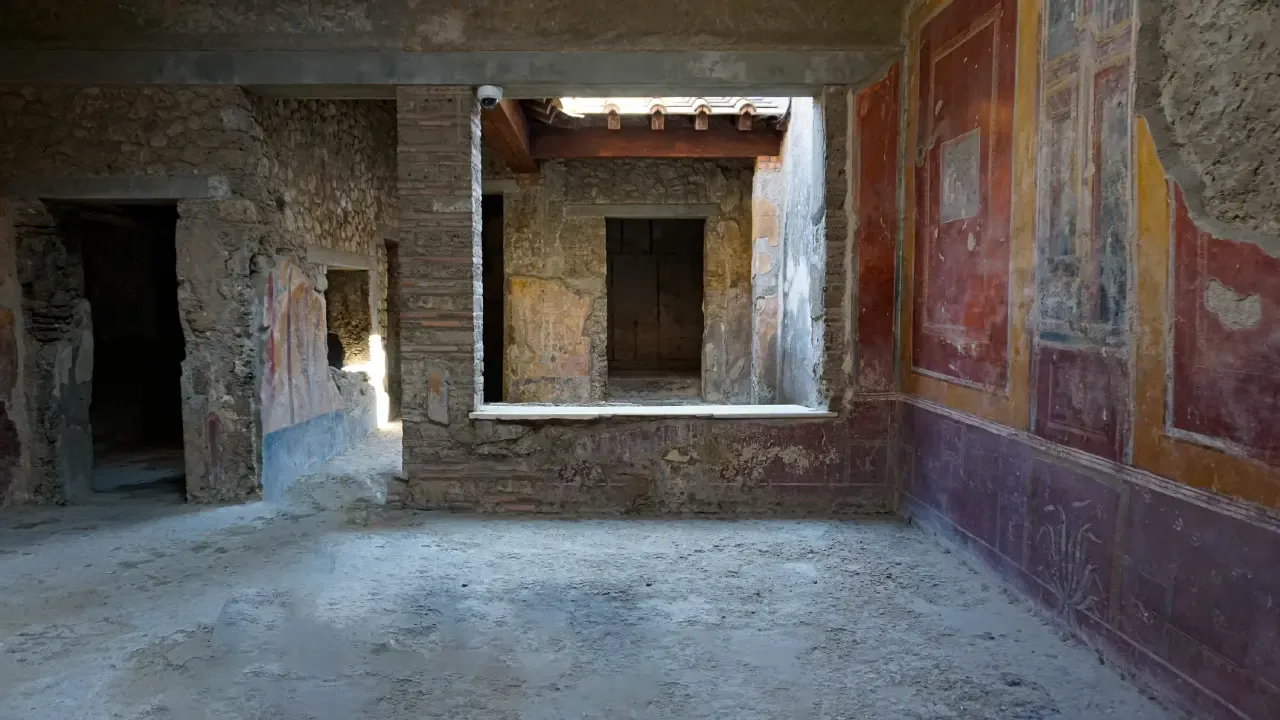
Here’s where Pompeii’s story gets really interesting. The House of the Vettii belonged to two brothers, Aulus Vettius Conviva and Aulus Vettius Restitutus, who were freedmen (former slaves) who’d made it big, probably in the wine trade. After the devastating earthquake of 62 AD drove many old aristocratic families out of Pompeii, ambitious entrepreneurs like the Vettii brothers rushed in to fill the vacuum.
You’ll know you’re in “new money” territory the moment you enter. The vestibule features a massive fresco of the god Priapus weighing his enormous erect phallus against a bag of coins. While phallic imagery was common in Pompeii as a good-luck charm, this version is unusually explicit and commercial. The brothers are literally equating their masculine power with their financial success.
5. Lupanar
5. Lupanar
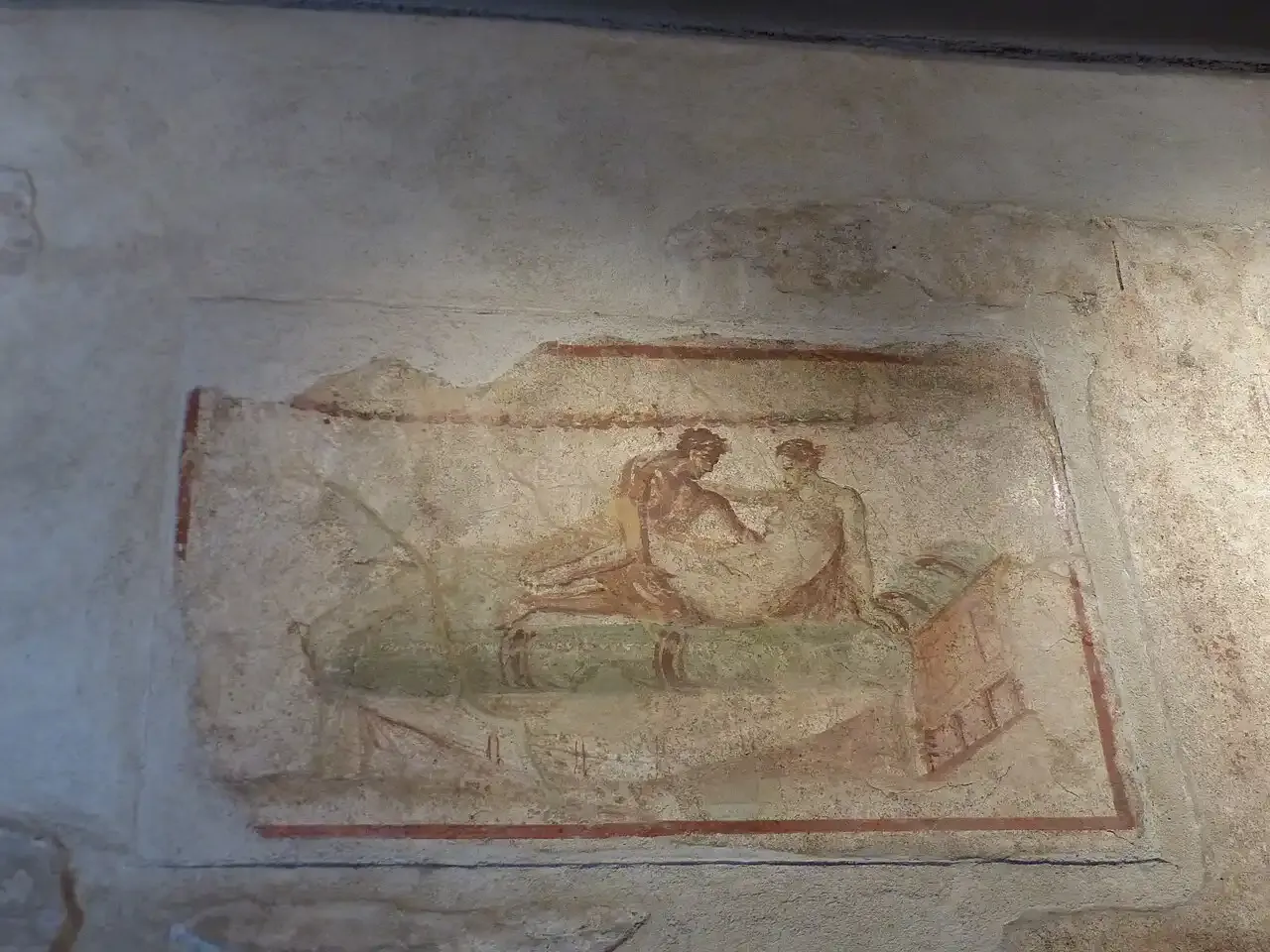
Let’s talk about Pompeii’s most famous brothel. The Lupanar sits at the intersection of two side streets, and it’s the only building archaeologists can identify with certainty as a purpose-built, commercial brothel.
What makes the Lupanar fascinating isn’t the building itself, it’s what’s written on the walls. Over 150 graffiti inscriptions were scratched into the plaster by both clients and the prostitutes themselves.
The Lupanar is a reminder that Roman society, for all its architectural genius and artistic achievement, was built on profound inequality. But those graffiti inscriptions? They give voice to people history usually silences, making this one of the most human places in all of Pompeii.
Photo: "Brothel in Pompeii, Italy, 2016" by Benjamín Núñez González.
6. Garden of the Fugitives
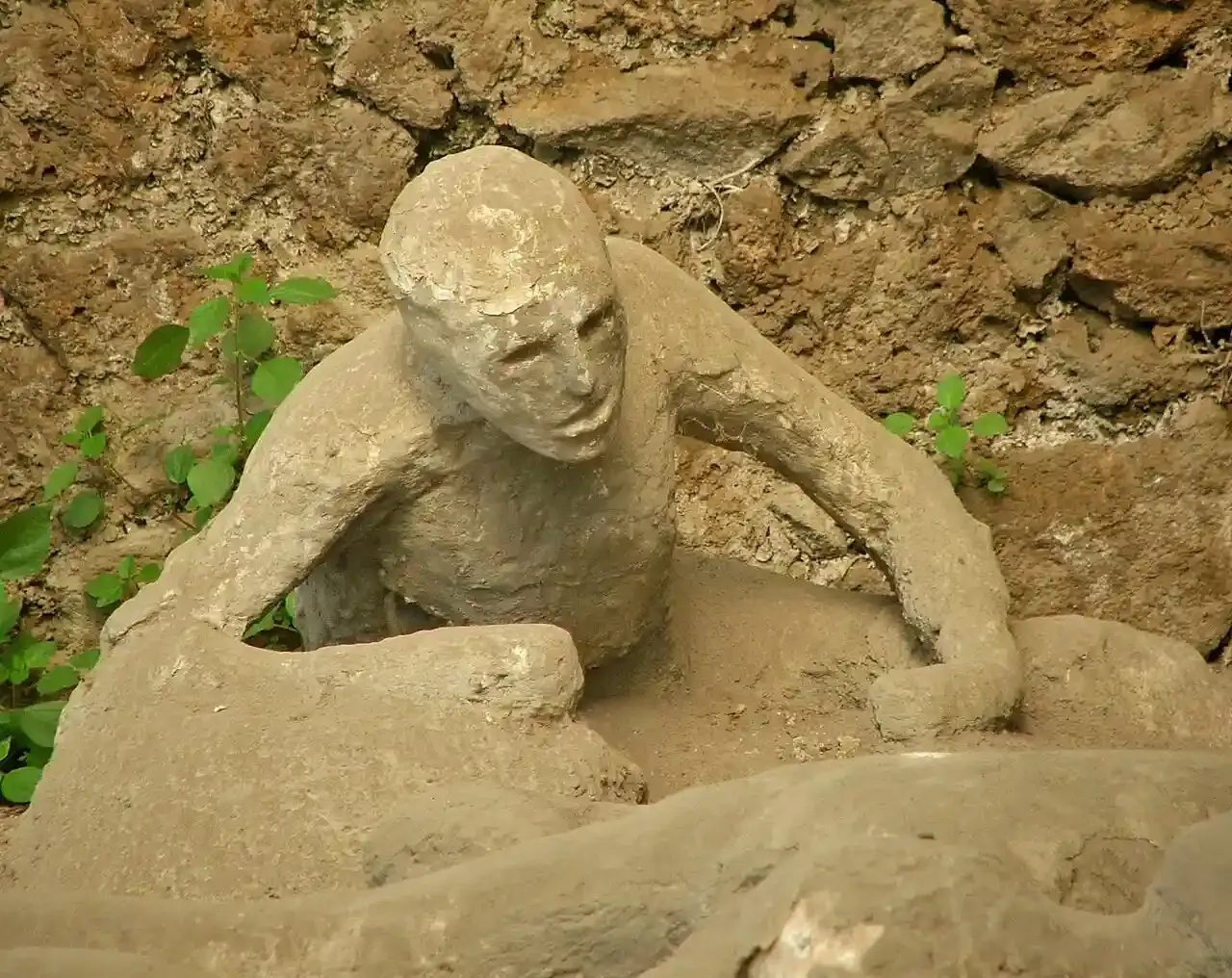
The Garden of the Fugitives transforms Pompeii from an archaeological site into a human tragedy. Located in a former vineyard near the Nocera Gate, this area displays thirteen plaster casts of victims preserved in their final moments. These individuals survived the initial volcanic bombardment but were overtaken by a fatal pyroclastic surge while desperately fleeing toward safety.
Their exact final postures, clothing folds, and facial expressions were captured using a brilliant technique developed in 1863 by Giuseppe Fiorelli. By pouring liquid plaster into the hollow cavities left by decomposed bodies in the hardened ash, he created poignant statues of the deceased. Today, these huddling families and fallen individuals offer a heartbreaking look at the disaster.
Photo: "The cast of the corpse of a victim of the 79 AD eruption of Mt. Vesuvius, found in the so-called Garden of the Fugitives in Pompeii" by Daniele Florio/Gridge.
7. Stabian Baths
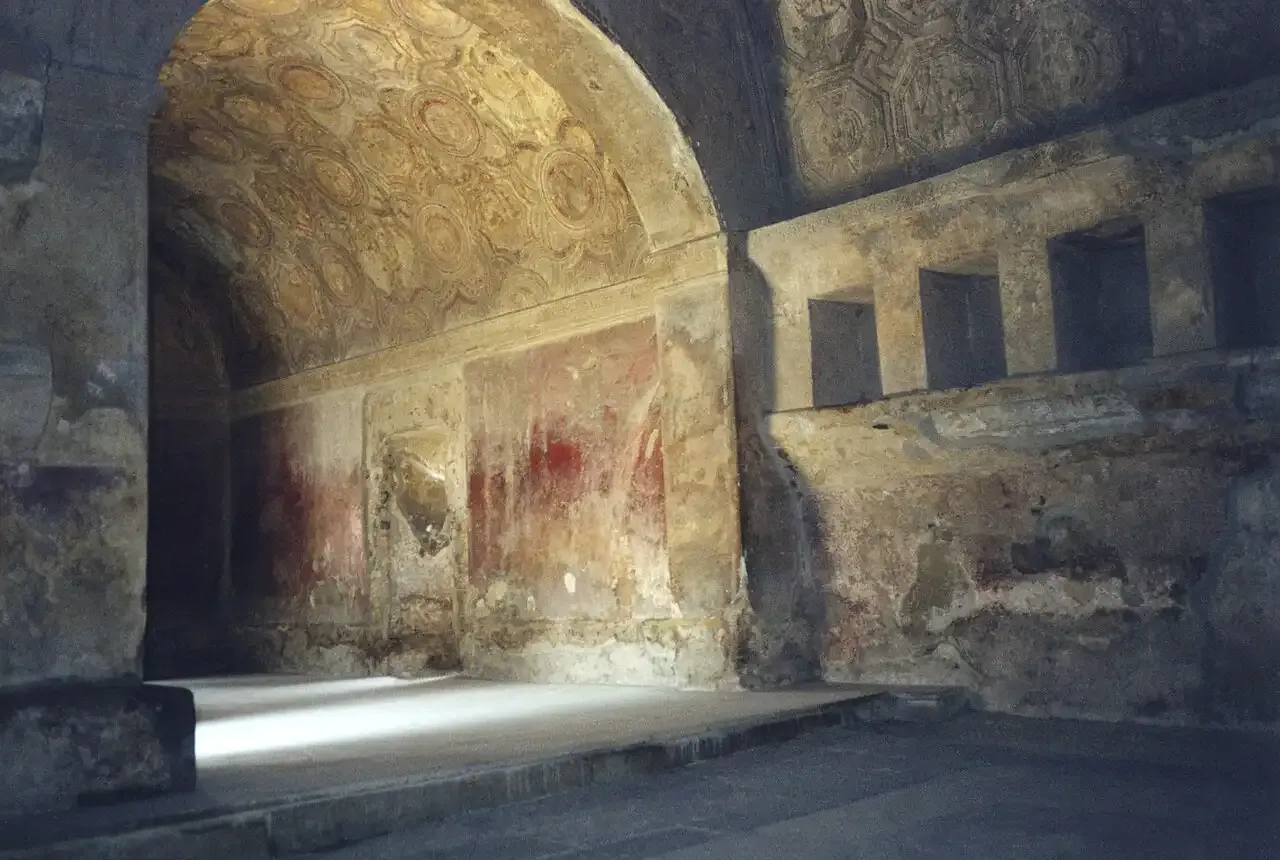
7. Stabian Baths
Dating back to the 2nd century BC, the Stabian Baths are the oldest and best-preserved public bathhouse in Pompeii. But don’t think of these as just a place to get clean. The baths were the ancient Roman equivalent of a community center, gym, spa, and social club rolled into one. Since most Pompeians lacked private bathing facilities at home, a daily trip here was essential, not just for hygiene but for networking, gossip, exercise, and relaxation.
The bathing ritual followed a specific health-oriented sequence. You’d start in the apodyterium (changing room), then move through progressively hotter rooms: the warm tepidarium, the hot caldarium for sweating and hot baths, and finally a bracing plunge in the cold frigidarium. The complex also featured a large courtyard, or palaestra, for wrestling and exercise, plus a swimming pool.
Photo: "Apodyterion (changing room) in the Stabian Baths at Pompeii in Italy" by AlMare.
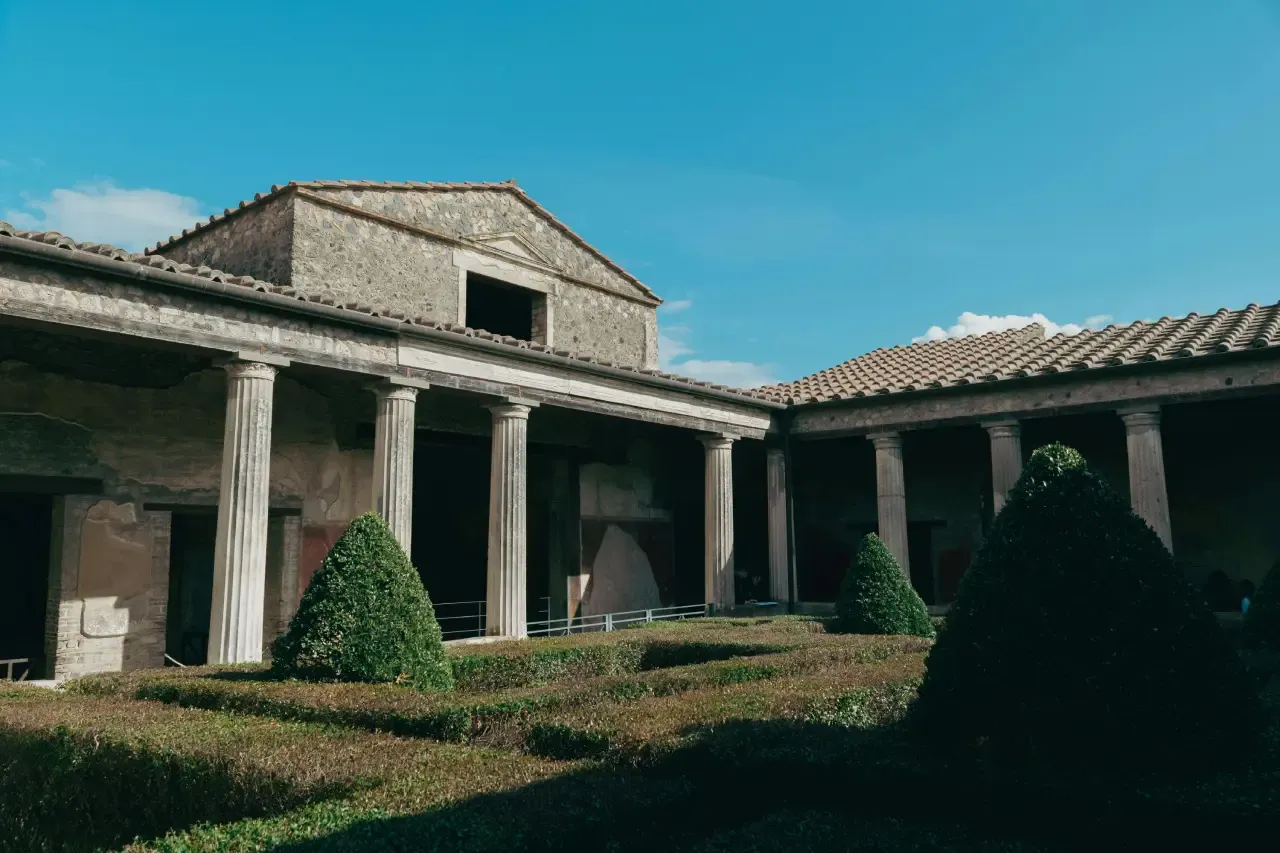
8. Villa of the Mysteries
The Villa of the Mysteries was a luxurious suburban estate combining aristocratic leisure with practical farming. But what draws visitors is a single room covered in nearly life-sized figures painted against a luminous “Pompeian red” background.
These frescoes have puzzled scholars for over a century. The most accepted interpretation is that they depict a woman’s initiation into the Dionysian Mysteries, a secret cult devoted to Dionysus (the god of wine, fertility, and ecstasy). Unlike formal state religion, mystery cults offered personal, emotional spiritual experiences and promised initiates special knowledge and benefits after death.
What to see in Pompeii beyond the main tourist attractions
Once you’ve hit the major highlights, don’t rush for the exit. Pompeii rewards those who wander beyond the well-trodden paths. These lesser-known spots won’t have the tour group crowds, which means you can take your time and really absorb what you’re seeing.
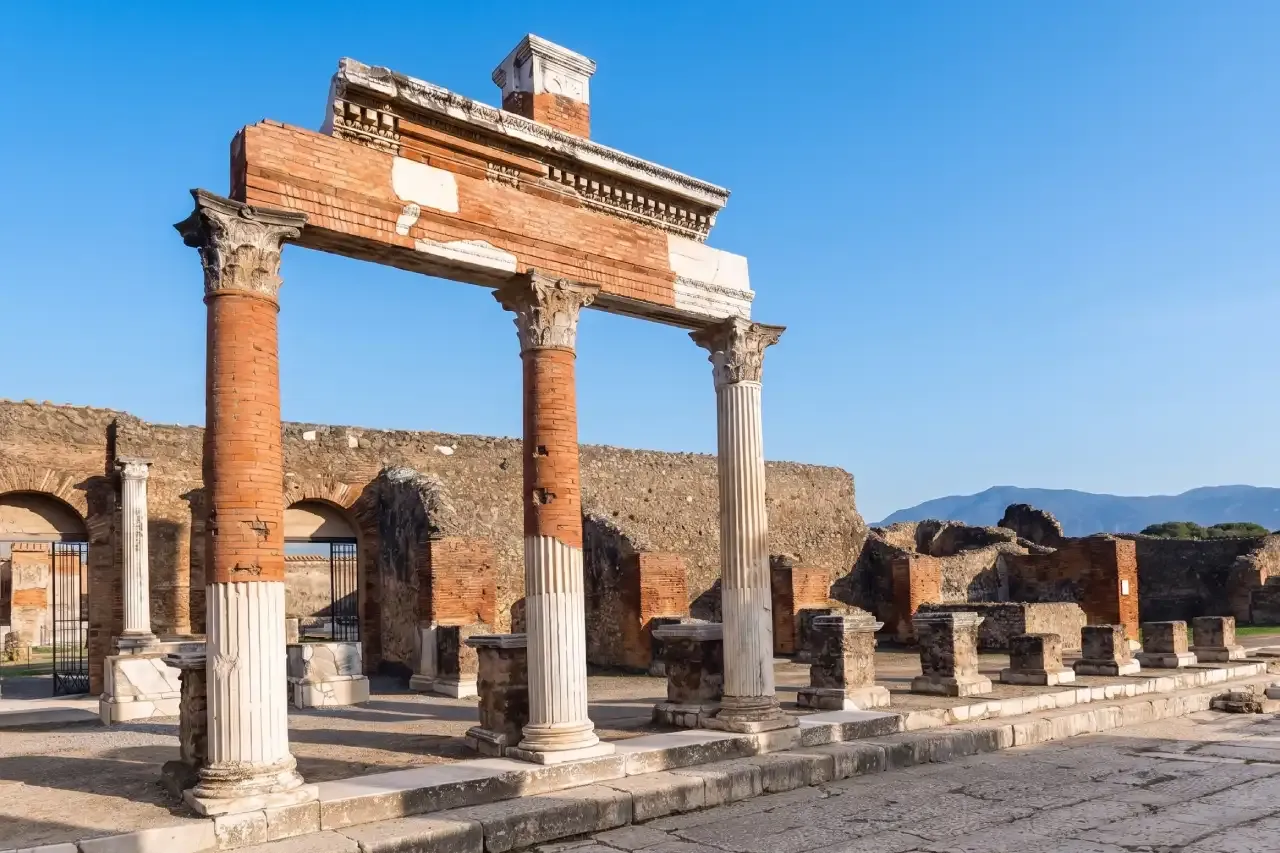
The Macellum
Strategically positioned on the Forum’s northeast corner, the Macellum was Pompeii’s main indoor food market, specializing in meat and fish. The building’s design shows remarkable practical intelligence. Many shops were deliberately placed on the north side to shield perishable goods from the harsh sun and keep them fresh. The central fishmonger’s area featured sloping counters and drainage channels to wash away water and waste, surprisingly hygienic for the ancient world.
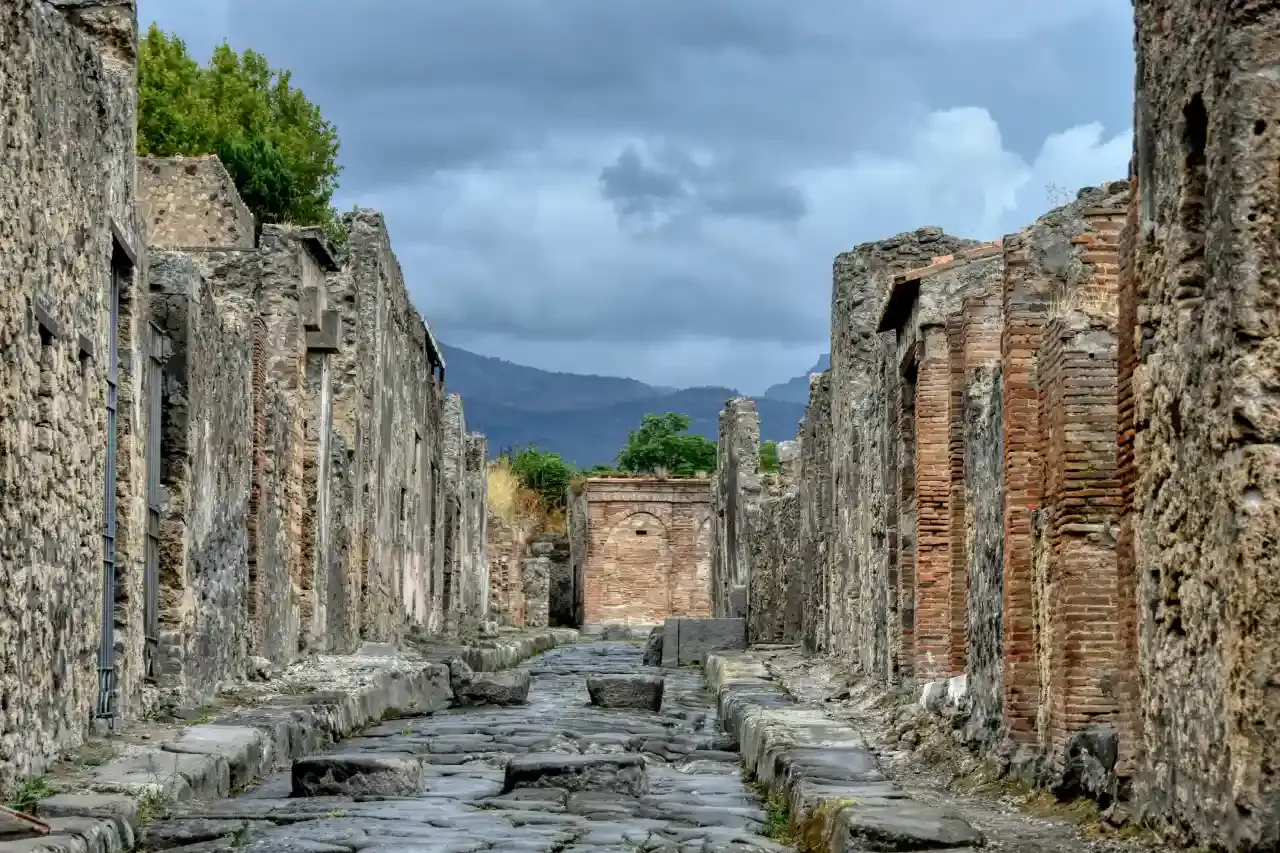
Ancient streets and stepping stones
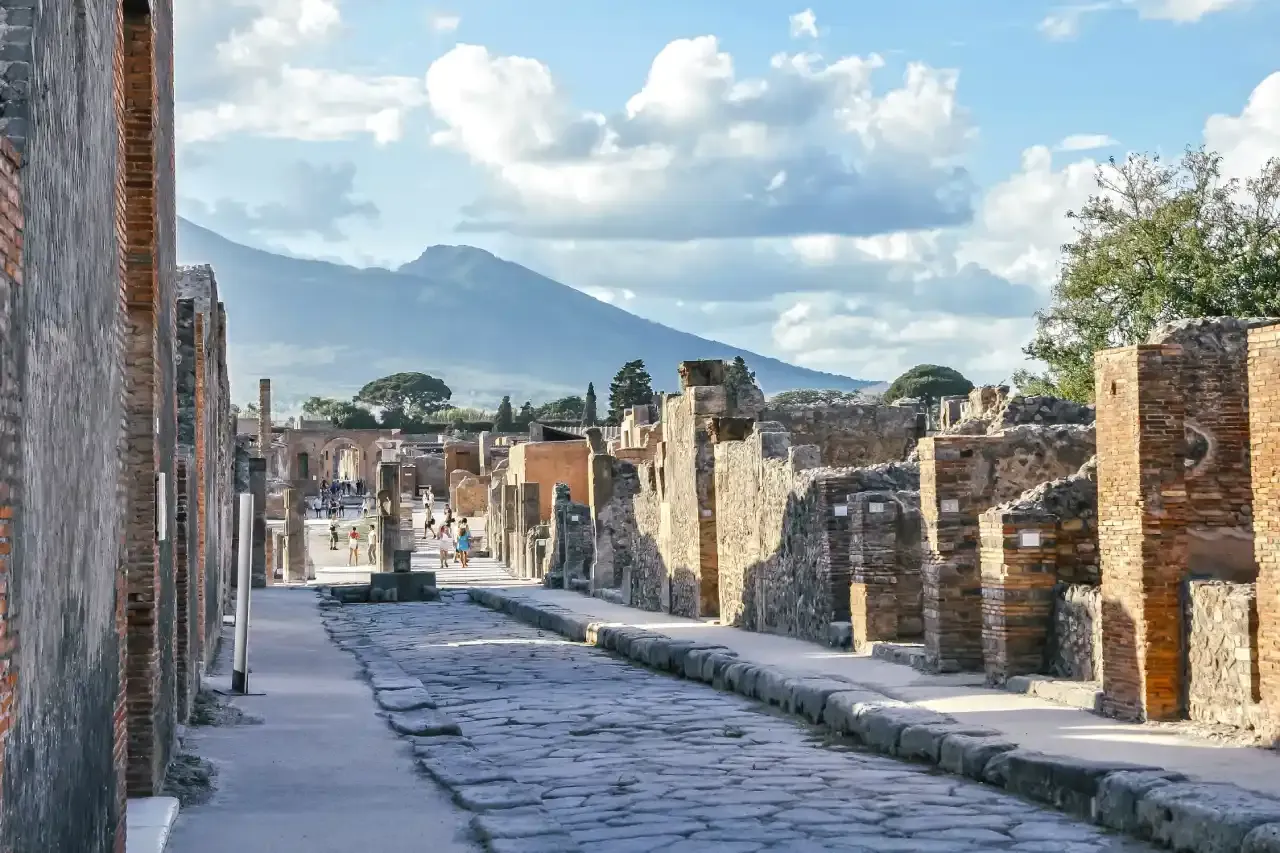
Take time to really look at the streets themselves, they’re remarkable pieces of urban engineering that solved a major problem of ancient city life. The large raised stones placed at intervals across roadways served a brilliant dual purpose: they allowed pedestrians to cross the streets without stepping into the rainwater, mud, and sewage that frequently accumulated on the pavement. In addition, the gaps between these stepping stones were precisely measured to match the standard wheelbase of Roman wagons, allowing traffic to pass through unobstructed.
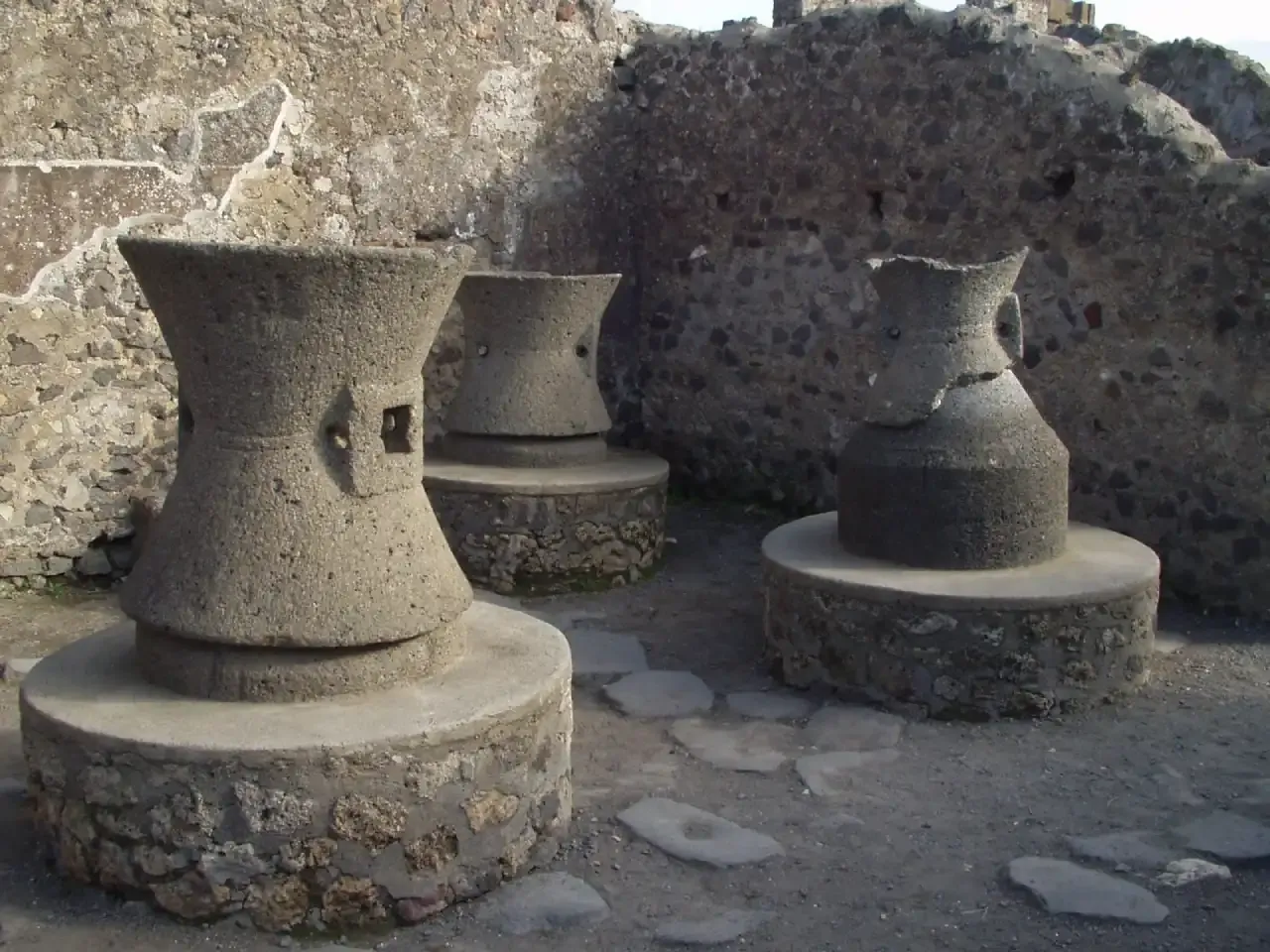
The bakeries
Bread was the cornerstone of the Roman diet, and Pompeii had roughly 30 commercial bakeries supplying the city. These pistrina are remarkably well-preserved, featuring large hourglass-shaped mills made of volcanic stone, typically turned by blindfolded donkeys walking in endless circles. The ovens are so intact that archaeologists have found perfectly carbonized loaves inside, some still stamped with the baker’s name.
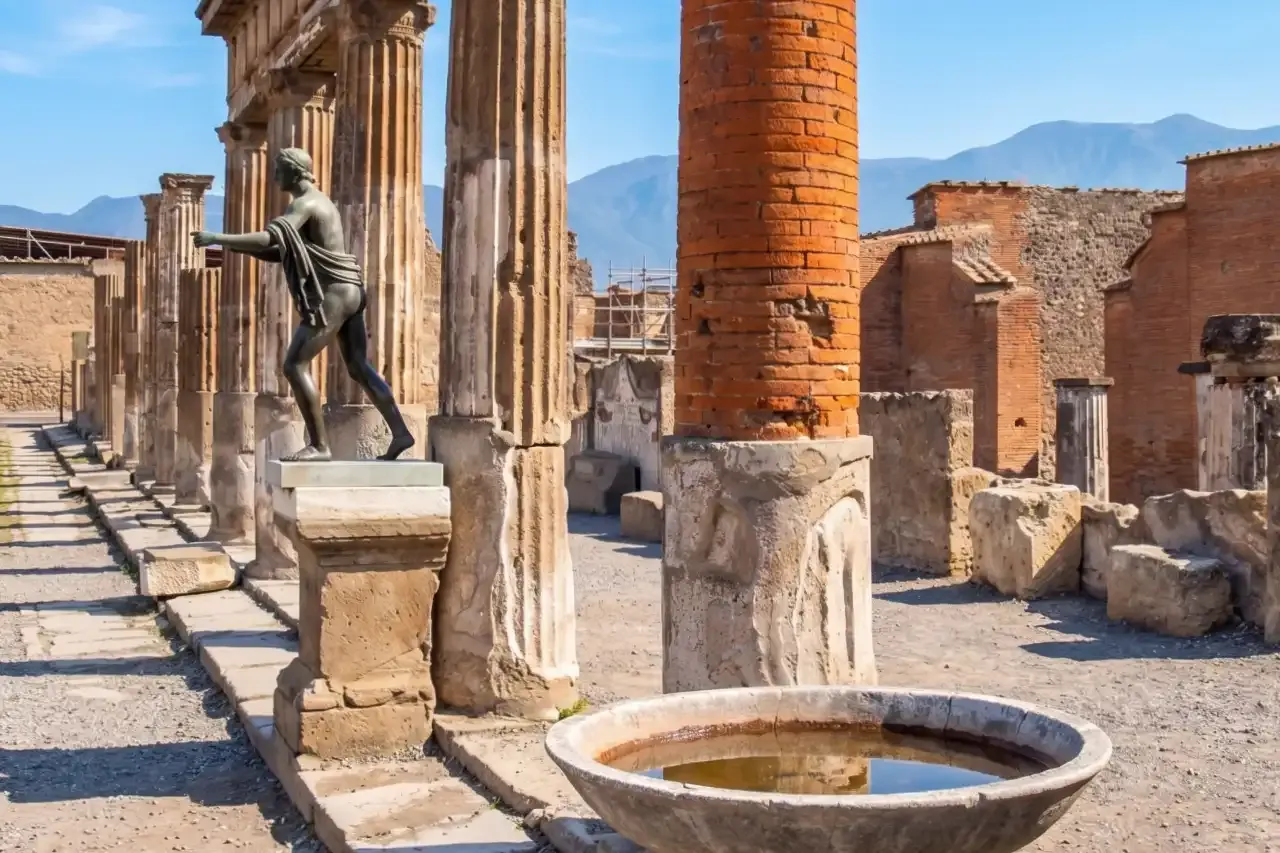
Temple of Apollo
As one of Pompeii’s oldest and most important religious sites, this sacred space reflects centuries of cultural evolution and architectural grandeur. Strategically located right next to the Forum, the sanctuary served as a primary hub for spiritual life, long before other imperial cults took prominence in the city. The impressive courtyard, framed by a continuous colonnade of Corinthian columns, created a dramatic setting for ancient worshippers. Today, the striking bronze statues of Apollo as an archer and his sister Diana (standing face-to-face across the grounds) remain powerful symbols of the city's enduring devotion to the Olympian gods.
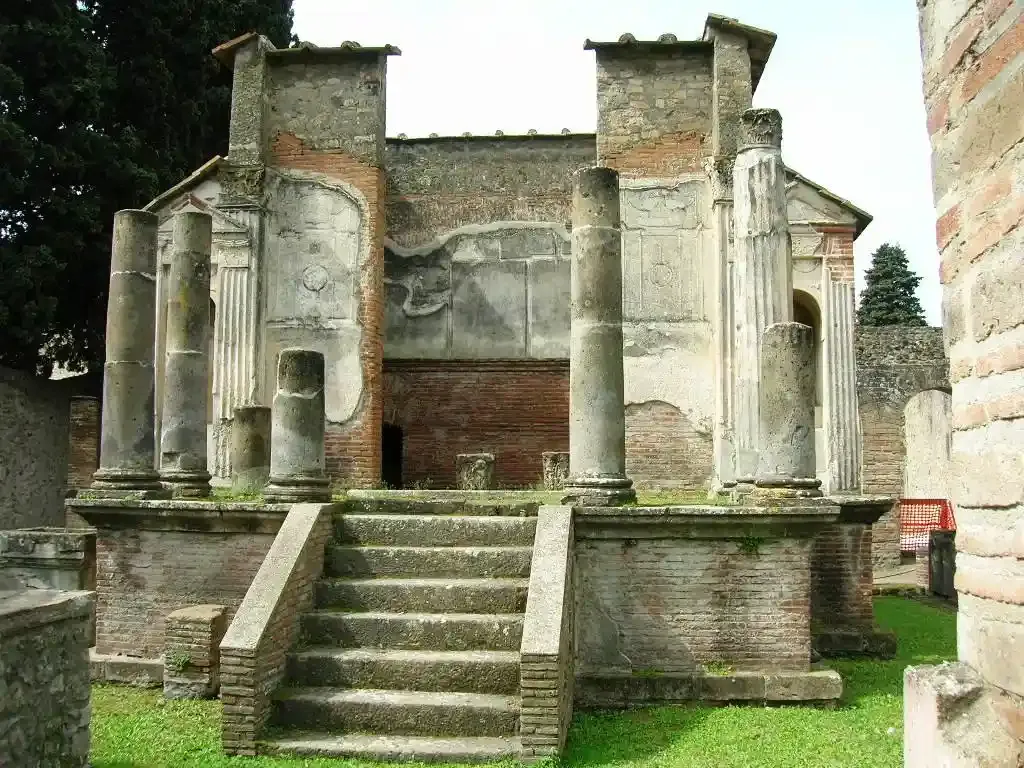
Temple of Isis
Tucked away near the Theater District, this remarkably preserved sanctuary offers a fascinating glimpse into the mystical and multicultural world of ancient Roman spirituality. Dedicated to the Egyptian goddess of fertility and rebirth, the temple became immensely popular among Pompeii’s lower classes, women, and freed slaves due to its promise of salvation. The compact complex features a distinct mix of Roman and Egyptian architectural styles, complete with a central high podium, a purgatorium for storing sacred Nile water, and beautifully detailed stuccoes. Interestingly, it was one of the very first structures to be completely rebuilt after the severe earthquake of 62 CE.
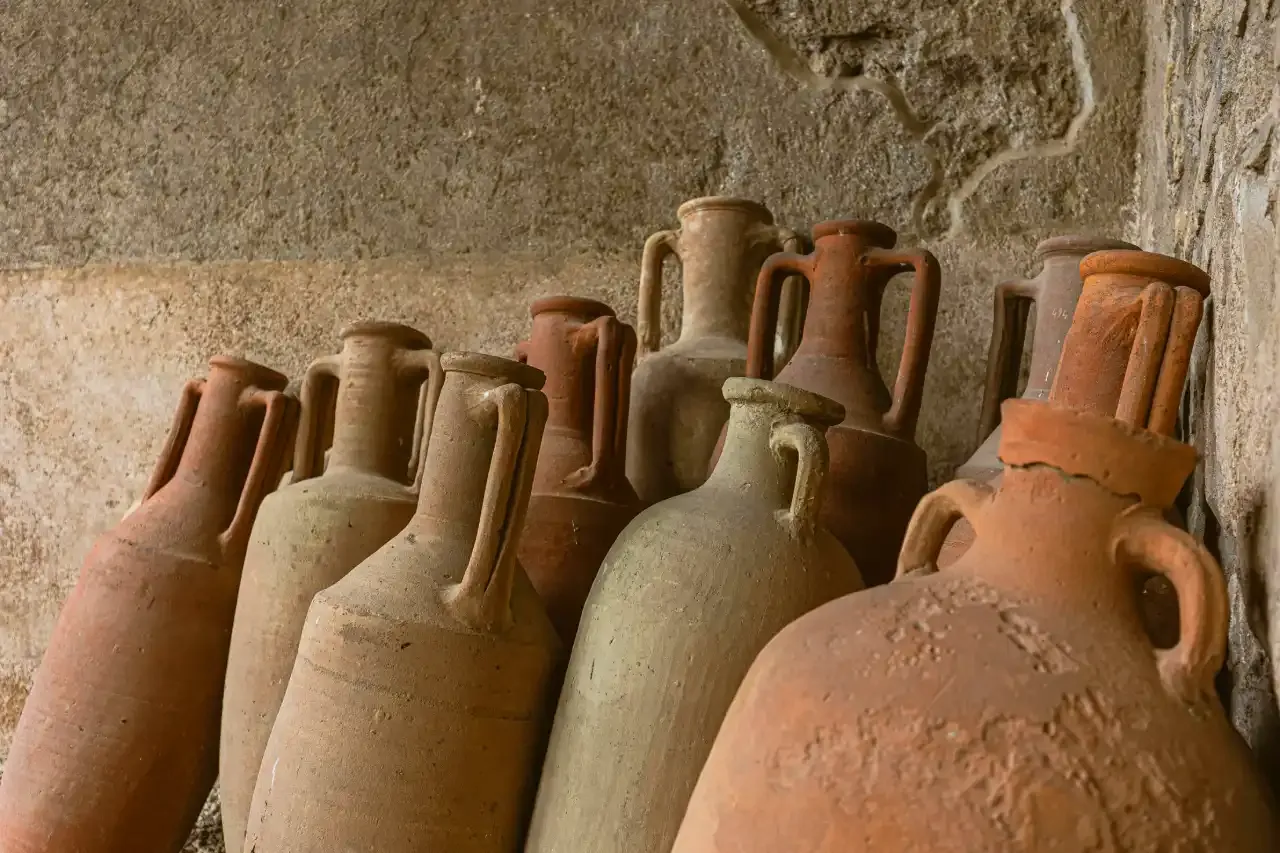
Forum Granary
Located right off the main square, this massive warehouse provides a fascinating look into both the commercial history and the tragic end of the city. Originally designed as a public market for grain, herbs, and dried pulses, the open-arched structure was still unfinished at the time of Vesuvius's eruption. Today, it serves as the ultimate archaeological repository, packed with over nine thousand artifacts recovered from the volcanic ash. As you look through the protective grates, you can see rows of terracotta amphorae used for storing oil and wine, ancient household tools, and even roof tiles stacked exactly as they were centuries ago.
Booking the Pompeii Entry Ticket
Specific things to do in Pompeii at night
Pompeii’s after-dark allure centers on meticulously curated seasonal programs that grant special access to the archaeological park. These typically run during the warmer months, primarily from July through October, focusing on weekend evenings (Fridays and Saturdays) with visiting hours usually from 8:00 PM to 11:00 PM or 11:30 PM. The last entry is generally around 10:00 PM, so don’t cut it close.
The nocturnal routes showcase some of Pompeii’s most spectacular areas: the magnificent Villa of the Mysteries, the grand public space of the Forum, the well-preserved Stabian Baths, the luxurious Praedia of Julia Felix, and the stunningly frescoed House of the Venus in the Shell. These aren’t random choices, they’re carefully selected spots that take on an entirely different character when experienced in low light and complete tranquility.
Beyond atmospheric walks, Pompeii’s evening programs transform its ancient spaces into living venues for contemporary art. A standout example is “POMPEII. VOX FEMINAE – The Secret Words of Women“, a theatrical series celebrating the lives of Pompeian women through a blend of theater, narration, and live music.
What you need to know before you go?
Opening hours
Pompeii opening hours vary depending on the season to provide the best visitor experience:
- From April 1st to October 31st, the site is open from 9:00 AM to 7:00 PM, with the last entry allowed at 5:30 PM.
- From November 1st to March 31st, the hours are slightly reduced from 9:00 AM to 5:00 PM, with the final admission at 3:30 PM.

Combining Pompeii with other nearby attractions
The Bay of Naples region is packed with extraordinary ruins near Pompeii and ancient Temples, and the smart move is to combine several into a journey that tells the complete story of this volcanic landscape and its 2,000-year relationship with humanity. Here are some of them:
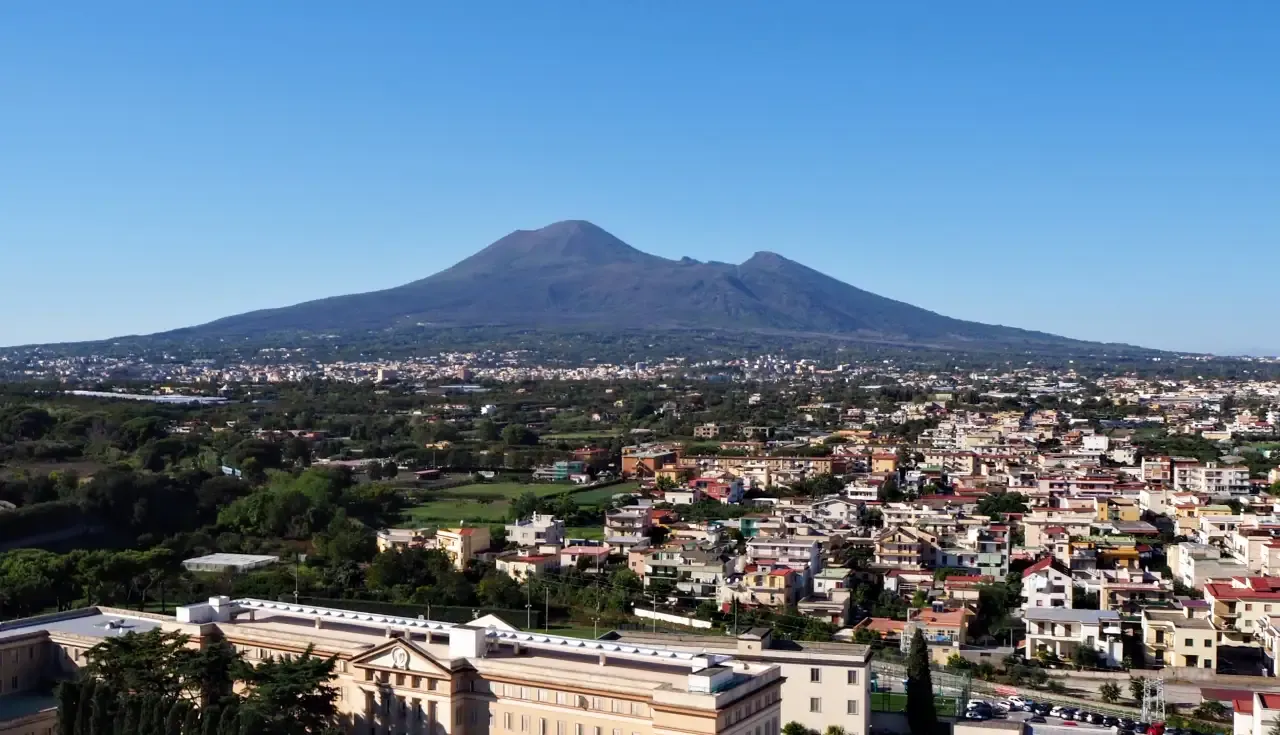
Mount Vesuvius
Why visit both Pompeii and Vesuvius? Because seeing the city without confronting the mountain that killed it leaves the story incomplete. Pompeii shows you the aftermath and Vesuvius shows you the cause. Standing on the crater rim, staring into the 450-meter-wide, 300-meter-deep volcanic mouth where steam still rises from fumaroles, gives you the physical reality behind the abstract historical event.
The most popular route is Path N. 5, “The Gran Cono”, which leads directly to the crater rim. The walk offers panoramic views of the Bay of Naples, the Sorrento Peninsula, and the sprawling modern city below.
Visiting both sites in one day is entirely feasible. Most people recommend seeing Pompeii first ,spending the morning and early afternoon walking the ancient streets, then heading to Vesuvius for the late afternoon climb. This timing gives you two advantages: the hike is cooler, and you’ll potentially catch sunset views from the summit.
Herculaneum
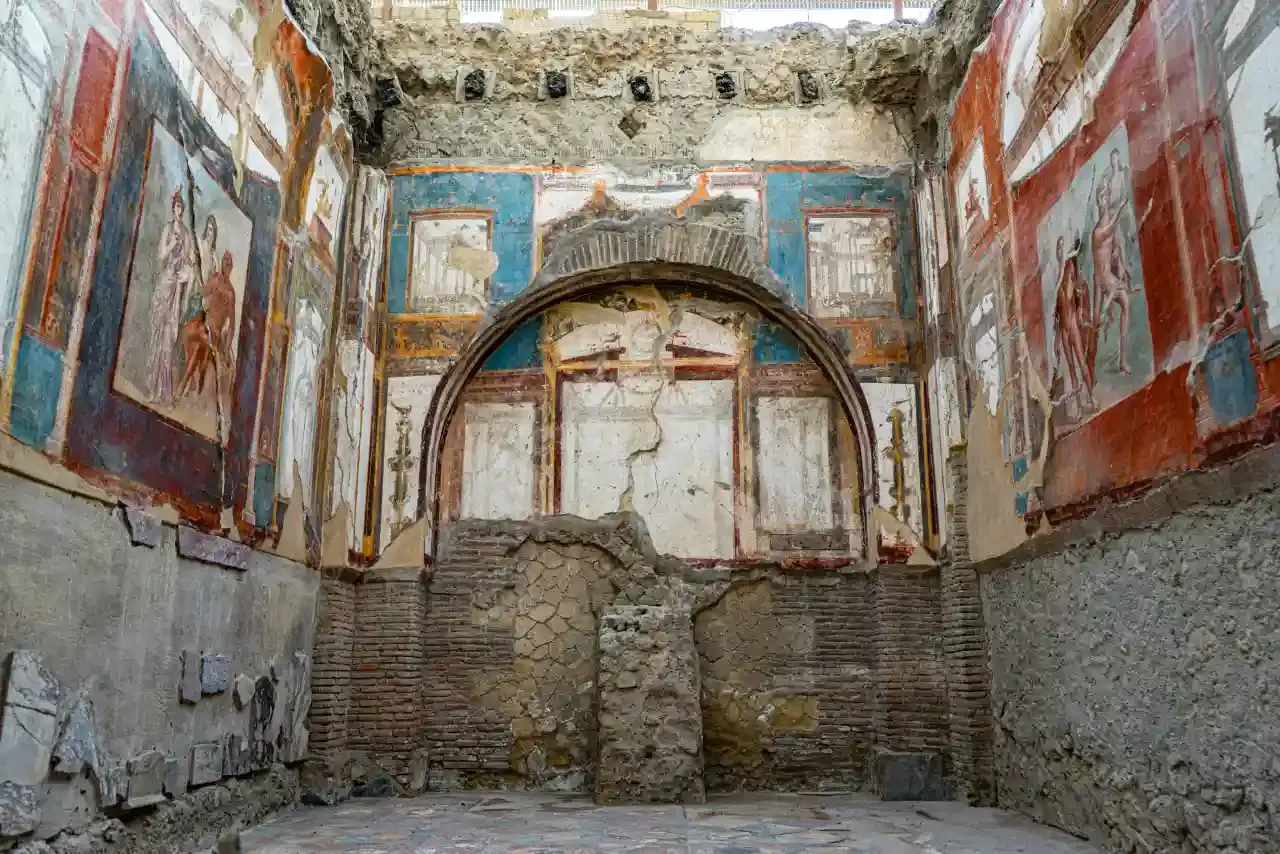
Herculaneum
While Pompeii gets the fame and the crowds, this smaller, wealthier seaside resort town offers preservation that borders on miraculous. Pompeii was buried slowly under 4-6 meters of ash and pumice, which caused roofs to collapse and destroyed organic materials. Herculaneum was engulfed instantly by pyroclastic flows that buried it under 20-25 meters of volcanic tuff, creating an airtight seal that preserved things Pompeii lost forever.
Herculaneum has original wooden doors, window frames, staircases, furniture, and even a baby’s crib. Pieces of cloth, fishing nets, and carbonized food items survived.
The site is also dramatically more compact and manageable than Pompeii’s sprawling 66 hectares. You can see Herculaneum’s highlights thoroughly in 2-3 hours, making it perfect for an afternoon visit after a morning in Pompeii.
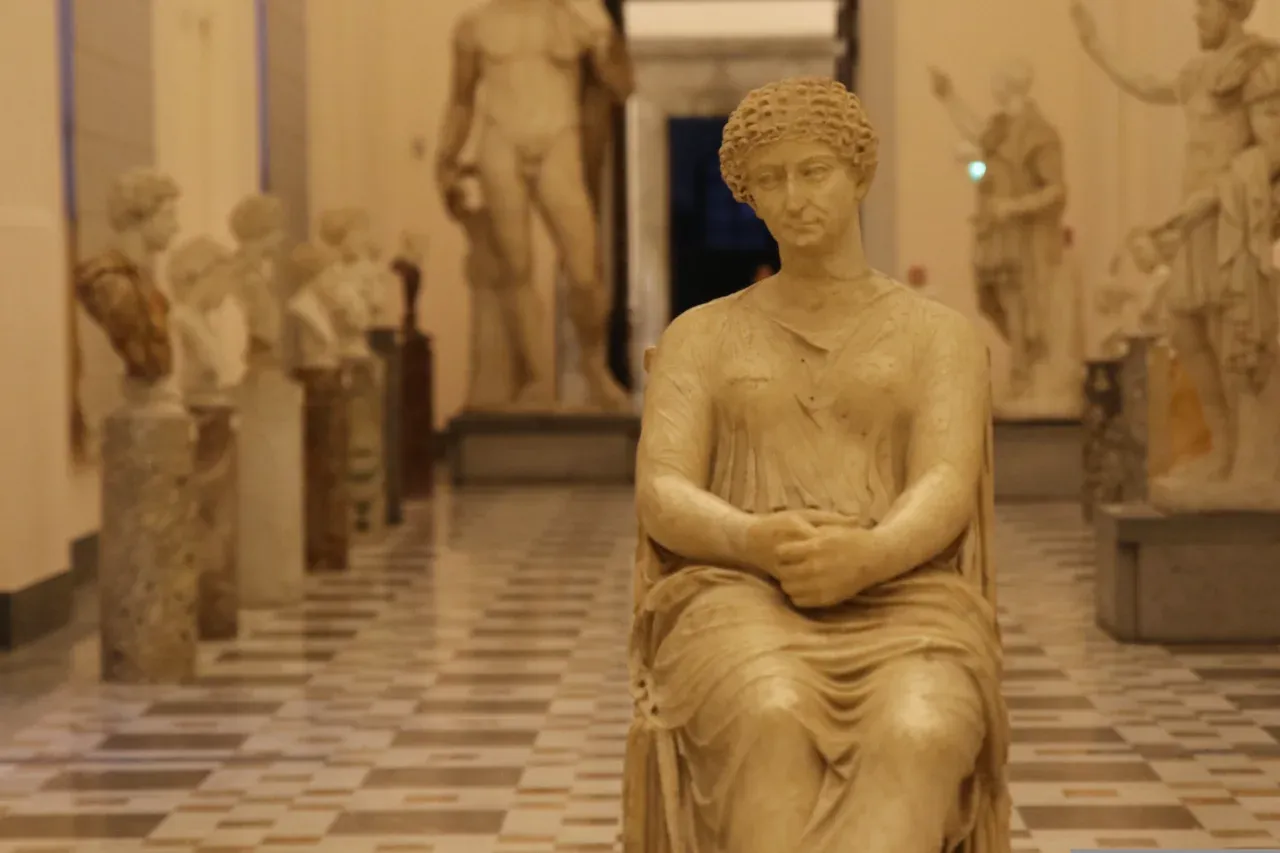
Naples Archaeological Museum (MANN)
Here’s what most visitors don’t realize until it’s too late: many of Pompeii’s greatest masterpieces aren’t in Pompeii. The finest frescoes, the most valuable mosaics, and majestic marble sculptures, like the seated portrait statue of a noblewoman dominating the gallery corridor, were removed for protection and preservation, transported to the Naples National Archaeological Museum (MANN). If you walk through Pompeii marveling at the art, you’re often looking at replicas. The originals are waiting in Naples.
The museum also houses the famous “Secret Cabinet” (Gabinetto Segreto), a collection of erotic and sexually explicit art that was considered so obscene by Victorian standards it was literally bricked up and kept from public view for nearly a century. It finally opened in 2000 and includes explicit frescoes from the Lupanar, sculptures of Priapus, and everyday household items shaped like phalluses or depicting sexual acts.
Other day trip options worth considering
So, you’re wondering what else to do after Pompeii? You’ve got some incredible options that really show off the whole region, all shaped by Vesuvius. If you’re still fascinated by the history but want to see pure, imperial-scale luxury, you have to check out Oplontis (Villa Poppaea). It’s thought to be Nero’s wife’s seaside villa, and it’s packed with stunning frescoes and an absolutely massive 60-meter-long pool, the best part is, you can see it all in about an hour.
But maybe you’re feeling a little “ruined out”? Then you should head to Sorrento. It’s a completely different vibe, a charming town perched on cliffs where you can just relax, explore shops, and enjoy the famous limoncello, all just a 45-minute drive away. And, of course, if you want that truly unforgettable, “pinch-me” scenery, there’s the Amalfi Coast. It’s a full-day commitment, and the winding road is no joke, but the views of towns like Positano and Ravello clinging to the cliffs are something you’ll never forget, making it easy to see how you could build an amazing 3-5 day trip blending it all.