
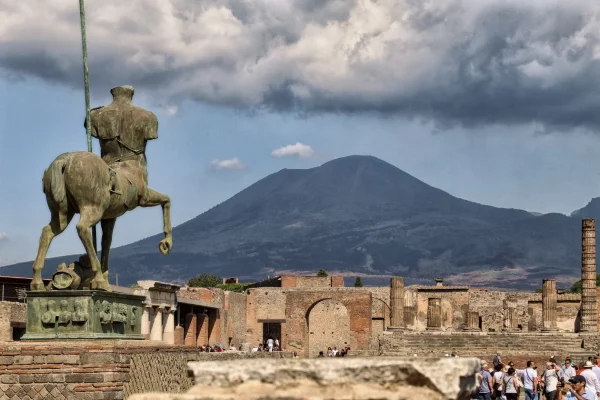
Pompeii is an archaeological destination that is well worth visiting, as it is a veritable time capsule from the Roman Empire era. The city was buried by Vesuvius in 79 AD, which has allowed its streets, frescoes, and architecture to be preserved in exceptional detail.
Is it worth visiting Pompeii?
One of the main reasons why it is worth visiting Pompeii is the incredible conservation of daily life. Thanks to the ash and pumice stone that buried it after the eruption of Mount Vesuvius, in 79 A.D., the details of the houses, the streets, and even the household objects remained intact. It is as if the people of the time had just left when you arrived.
Furthermore, Pompeii offers you a monumental scale that you don’t easily find. You have the imposing Forum, the great Amphitheater, and the extensive streets that make you feel the immensity of this ancient Roman city.
By walking around there, you truly realize how a city of that era functioned: you observe the bakeries, the thermopolia (fast food restaurants), the public baths, and the villas. It is a total immersion into the Roman world.
On the other hand, you have the entire archaeological area of the Gulf of Naples, and visiting Pompeii becomes the perfect complement to its “little sister,” Herculaneum. Yes, both suffered the same terrible eruption of 79 A.D., but they were affected in different ways.
While Pompeii was covered by a rain of ash and pumice stone, Herculaneum was buried by pyroclastic flows that hardened and preserved organic materials incredibly well. Seeing both gives you a complete and contrasting image of the disaster and how the life of two neighboring cities was stopped in different ways.
The combination of both visits, along with climbing Vesuvius, transforms a simple day of tourism into a profound lesson in history and vulcanology. It is an enriching experience that is completely worthwhile.
In short, we can say that Pompeii is the time capsule we have of the Roman Empire. As we mentioned earlier, on the morning of August 24, 79 A.D., the eruption of Mount Vesuvius buried this bustling city, stopping the lives of its inhabitants in their daily course. It is an unrivaled archaeological record that allows us to understand the life, architecture, and art of an upper-middle-class Roman city.
Around it you will find things to do and places of great tourist and historical importance, such as The Forum, for example, the political, religious, and commercial heart of the city. There you will see the ruins of the temples, the triumphal arches, and the public buildings.
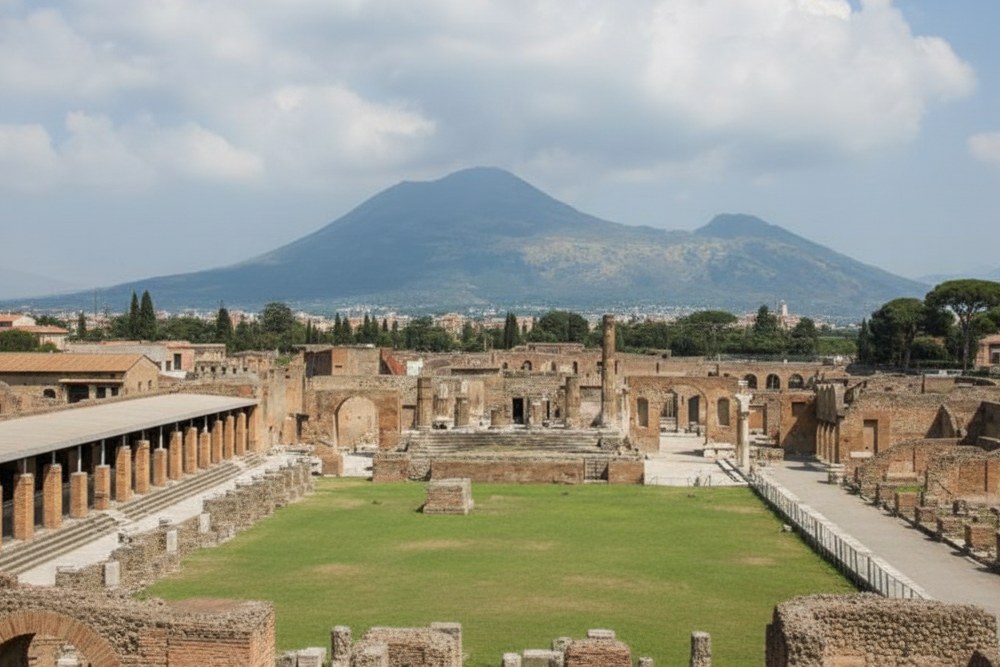
A little further away, there is the Amphitheater, one of the oldest preserved in Italy. Imagine the gladiatorial spectacles that were held here, it is a place loaded with a lot of history!
Regarding the houses, the House of the Faun is one of the largest and most luxurious private residences in Pompeii, famous for its impressive Alexander Mosaic (although the original is found in the National Archaeological Museum of Naples, which we recommend you visit). Then you have the House of the Vettii, known for its vivid frescoes that adorned its walls, showing mythological scenes and scenes from daily life.
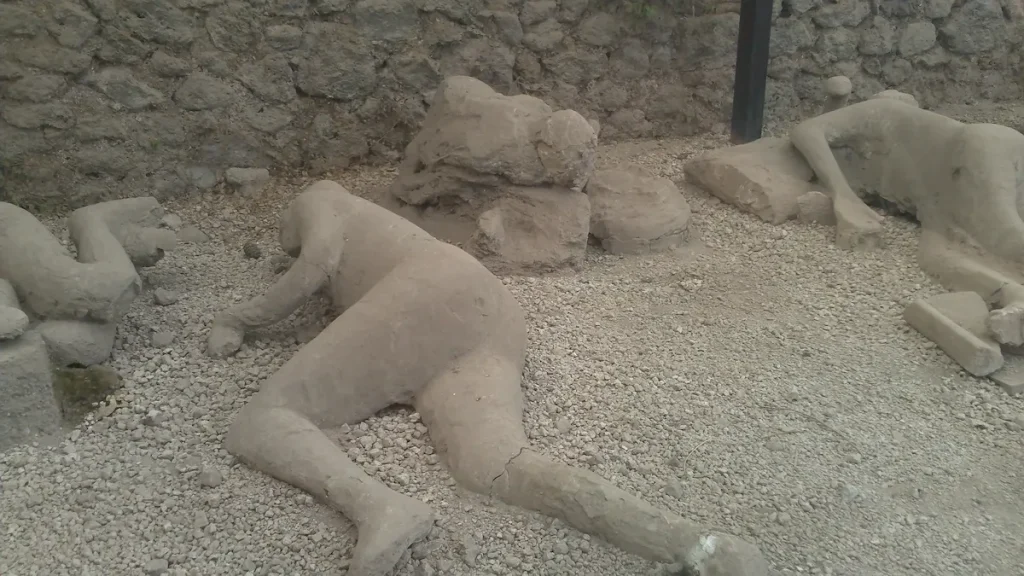
The Garden of the Fugitives is perhaps one of the most moving places, as the plaster casts of thirteen eruption victims are found there, captured right at the moment of their death. It is a shocking sight of the tragedy.
Finally, and if you have time to walk a little further outside the walls, do not miss the Villa of the Mysteries. Its frescoes, especially the room that gives the villa its name, are of exceptional quality and show what are believed to be Dionysian initiation rites. The richness of detail in these murals is, simply, overwhelming.
As you can see, the importance of Pompeii lies in this wealth of details which, when seen in person, allows you to connect with humanity from almost two thousand years ago in an incredibly real and practically palpable way.
Yes, Pompeii fits perfectly into any itinerary that includes these three cities, although with nuances. The most common is for travelers to incorporate it as a day trip, so, if you are planning a trip through Southern Italy, stopping in Pompeii is a must. Why? Because it is the perfect historical contrast between imperial Rome and modern Naples.
Now, although the most ideal destinations are Naples or Sorrento, due to their proximity, it is totally possible to visit Pompeii from Rome. The decision will lie in the logistics and how much time you need to rest. Are you willing to invest many hours in transport to return to the capital at the end of the day? If your answer is positive, it is important for you to know that the connection is good, but the duration of the trip is what makes the difference.
Doing a day trip to Pompeii from Rome is a popular option, but it requires careful planning and an early start. You have to count on at least 2 and a half to 3 hours of travel on a high-speed train to Naples, and then a change to the local Circumvesuviana line, which takes you directly to the entrance of Pompeii (about 30-40 minutes more).
If you opt for the day trip, you will have to sacrifice time in Rome or comfort. Imagine: you leave at 6 a.m. to arrive in Pompeii at 10 a.m. or 10:30 a.m., spend about 4 to 5 intense hours in the ruins, and you are back in Rome close to 8 p.m. Although it is feasible, it could leave you exhausted.
The alternative we propose is to stay one night in the Naples or Sorrento area. This allows you to leave Rome at a more comfortable time, visit Pompeii calmly, and return to Rome the next day. If your time is very limited and you can only dedicate one day, the trip from Rome is the only option, but if you can extend your stay, staying in the area will give you a much more relaxed and complete experience.
If your main objective is to explore Pompeii and the Amalfi Coast, Naples or Sorrento are ideal. These cities are very close to the ruins and both have an excellent connection with the Circumvesuviana train line.
Naples is a city with high tourism that offers incredible nightlife, world-class gastronomy, and, most importantly, it is the place where the National Archaeological Museum is located, where most of the original treasures of Pompeii are found. Furthermore, it is only about 25-30 minutes by train to Pompeii.
On the other hand, Sorrento, although a little further away (about 45-60 minutes from Pompeii), is a city that offers coastal tourism that may be of interest. It is quieter, more touristy, and serves as the perfect gateway to the Amalfi Coast and the island of Capri. If you are looking for a more picturesque and relaxed destination to rest after a day of walking, Sorrento is the best choice.
Both options eliminate the need for long journeys, making the visit to Pompeii worthwhile and a half-day or full-day event, but without the stress of having to return to Rome that same night.
Pompeii is a must-see if you want to travel to Italy. This country is rich in history, but the opportunity to see a Roman city so perfectly preserved is a unique experience that complements the imperial grandeur of Rome, the Renaissance art of Florence, and the charm of Venice. Not including it would be missing a key piece of the Italian historical puzzle.
Other places that are usually considered essential on a trip through Italy, besides the capital and Pompeii, are the Colosseum and the Vatican in Rome, the Uffizi Gallery and the Duomo in Florence, and the romanticism of the canals of Venice. If you have limited time, the key is to connect the points efficiently.
Next, we share a 10-day itinerary including Pompeii that can serve as inspiration to organize yours:
These are a few tips that will help you make the most of your visit to Pompeii and that, after applying them, you will have seen that it is totally worthwhile:
POMPEII TICKETS
TOURIST INFORMATION
POMPEII INFORMATION


